Trainer Review
Wahoo Kickr Core 2 Review
Seven years after the original, the Core gets WiFi, a faster data pipe and a heart-rate relay. Everything that made it the default mid-range trainer is untouched — including the accuracy figure.

The original Wahoo Kickr Core arrived in 2018 and then sat, unchanged, while the rest of the category iterated around it. It kept selling anyway, because it got the two things that actually matter right: it was direct drive, and it was heavy enough to feel like a bicycle. Almost every mid-range trainer released since has been measured against it.
The Core 2 is the first real revision, and Wahoo has been unusually disciplined about what it touched. The frame, the resistance unit, the flywheel and the accuracy claim are broadly carried over. What changed is how the trainer talks to your software — and if you have ever had a workout fall apart because a Bluetooth connection dropped mid-interval, you already know why that was the right place to spend the engineering budget.
WiFi is the upgrade, and it is bigger than it sounds
Every complaint people have about indoor training that is not about the pain is really a complaint about the radio link. The trainer drops out at the top of an interval. ERG stops holding. The controllable connection quietly downgrades to power-only and you spend the next ten minutes wondering why the resistance stopped changing. Almost all of it traces back to Bluetooth, which was designed for short-range accessories in a quiet radio environment — not for a room containing a phone, a tablet, a head unit, a heart rate strap and a set of speakers.
WiFi replaces that link entirely. The trainer joins your home network and talks to the app over IP, the same way a laptop does. There is no pairing dance, no range limit inside a normal house, and no contention with the other Bluetooth devices in the room. It also means firmware updates arrive without a phone involved.
Until the Core 2, this was a flagship feature: on Wahoo's side it lived on the Kickr v6 and the Kickr Move, both a long way up the price list. Getting it at this tier is the strongest single argument for the Core 2 over anything else in its price band, and it is the reason our connection troubleshooting guide is largely irrelevant to people who own one.
Race Mode: 10 Hz, and who it is actually for
Race Mode transmits power to the app at 10 Hz instead of the usual once per second. In plain terms, the app learns what your legs are doing ten times a second rather than once. On a steady endurance ride the difference is invisible. In a Zwift race sprint, where the gap between launching an effort and the game reacting to it decides whether you hold a wheel, it is the difference between the avatar responding with you and responding a beat late.
Be honest with yourself about whether you are that rider. If your indoor riding is structured intervals and endurance work, a faster data rate changes nothing about your training. If you race on Zwift, it is a genuine competitive feature, and it did not exist at this price before.
Kickr Bridge: one fewer thing to fall over
Bridge lets the trainer receive your heart rate strap and pass the data on to the app as part of its own stream. The value is not the heart rate itself — it is that your phone or laptop now maintains fewer simultaneous connections. Every device you remove from the Bluetooth chain is a device that can no longer drop at minute thirty-eight of a threshold session.
It works with standard straps, so whatever you already own is likely fine; our heart rate monitor roundup covers what to buy if you are starting from scratch.
| Kickr Core 2 | Kickr Core (2018) | Kickr v6 | Elite Rivo | |
|---|---|---|---|---|
| Type | Direct drive | Direct drive | Direct drive | Direct drive |
| Claimed accuracy | ±2% | ±2% | ±1% | ±2.5% (estimated) |
| Max resistance | 1,800 W | 1,800 W | 2,200 W | 2,000 W at 40 km/h |
| Max gradient | 16% | 16% | 20% | 18% |
| Flywheel | 5.4 kg | 12 lb | 16 lb | 4 kg |
| Onboard WiFi | Yes | No | Yes | Yes |
| ANT+ FE-C | Yes | Yes | Yes | No |
| Fast data rate | Race Mode, 10 Hz | No | Model dependent | No |
| Heart-rate relay | Kickr Bridge | No | Yes | No |
The accuracy figure did not move, and that is fine
±2% is the same claim the 2018 Core carried. Wahoo could have quietly inflated the number; it did not, and the Core 2 is a better product for the restraint.
Two percent sounds large until you work out what it buys you. At 250 W it is a five-watt window. Structured training does not care about five watts, because training runs on repeatability: if the trainer reads the same way every session, your zones are internally consistent, your intervals are correctly graded against each other, and your fitness trend is honest. Our accuracy guide makes that case at length, and it is the most misunderstood idea in indoor cycling.
Where ±2% costs you is comparison. Racing against a field on ±1% hardware, or following a plan built on an FTP measured outdoors with a power meter, both put your number next to someone else's. If that describes your riding, the extra you would spend on a v6 is buying something real.
1,800 W, 16%, and the numbers that do not matter
The Core 2 tops out at 1,800 W and simulates a 16% gradient. Both are lower than the flagship, and for almost everyone both are irrelevant.
Eighteen hundred watts is a number a strong amateur sprinter touches for two or three seconds a handful of times a year. Sixteen percent is steeper than the great majority of what Zwift throws at you, and most riders run trainer difficulty below 100% anyway, which scales the simulated gradient down so a virtual wall does not demand a gear the bike does not have.
The spec that will actually shape your rides is the 5.4 kg flywheel. Flywheel mass carries your momentum through the dead spots at the top and bottom of the pedal stroke, and 5.4 kg is a lot for this tier — noticeably more settled than the 4 kg Elite Rivo, if short of the 16 lb of a v6.
Should you upgrade from the original Core?
Probably not, and we would rather say so. If your Core works and your connection is stable, the Core 2 gives you a faster radio and a heart-rate relay on the same drive unit, the same flywheel class and the same accuracy claim. That is not a season-changing upgrade at full price.
The exception is a genuinely bad radio environment — a flat with a dozen networks in range, a garage a long way from the router, a room where dropouts are a weekly event rather than a rare one. There, WiFi is not a convenience, it is the fix, and a Core 2 solves a problem no accessory can. Our garage pain cave guide covers the rest of that scenario.
If your money is looking for the biggest available improvement instead, spend it outside the trainer. A serious fan changes more about how an hour indoors feels than any drive unit does.
Living with it
Setup is the easiest of any direct-drive trainer we have written up: the legs arrive attached and the job is fitting a cassette and plugging it in. If you are supplying your own, our cassette guide covers matching it to your chain — and note that the Core 2 is also sold in a Zwift Cog configuration, which removes the cassette question entirely in exchange for virtual shifting. That Zwift Cog version is also the trainer inside the Zwift Ride bundle, so if you would rather skip mounting a bike altogether, our Zwift Ride review covers the same trainer in a complete frame, and the best smart bikes roundup prices that route against the rest of the class.
Noise is a non-issue, as it is on every direct-drive trainer, because the tire is out of the equation and what remains is your own drivetrain. Buy a mat regardless — sweat is corrosive and floors are expensive.
Who should buy it
Buy the Core 2 if you are stepping up from a wheel-on trainer or building a first setup and you want to spend once. It is the cheapest trainer we know of that carries the connectivity of a flagship, and connectivity is what people actually complain about.
Buy something else if you race and want ±1% and 2,200 W — that is the Kickr v6 — or if long rides are what break you, in which case the movement rail on the Kickr Move solves a problem no amount of data quality will. And if the budget is genuinely tight, the budget tiernow contains real direct-drive options. The one that lands at almost exactly the Core 2's price is the Elite Rivo, and it beats the Wahoo on paper — Kickr Core 2 vs Elite Rivoexplains why we still point most riders here. A tier above, Elite's Avanti answers the Core 2 with a ±1% claim, a wired Ethernet port and automatic calibration for a clear price step — Elite Avanti vs Kickr Core 2works out who that is actually worth it for. And if the sticking point is not the money but the ritual of pulling the rear wheel out every time, Wahoo's own answer to that is the Kickr Rollr, which keeps the bike whole and asks you to supply the power meter instead.
A specific reason riders arrive at the Core 2: it is what Zwift's own trainer became. Our Zwift Hub review covers what happened to that trainer after the Wahoo patent settlement and why the Core 2 with a Zwift Cog is the direct replacement, which is worth reading if you were originally shopping for a Hub.
Comparing the whole field?
See where the Core 2 lands in the full rankingThe full reviews
Every pick, in detail
Best mid-range trainer
Wahoo Kickr Core 2
9.09.0 out of 10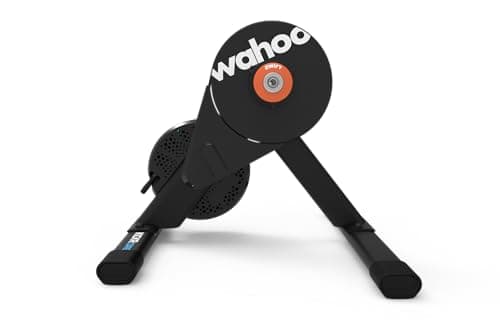
#ad We may earn a commission · Price as of October 22, 2026
The trainer most riders should buy: flagship connectivity and a heavy flywheel at a fraction of flagship money, with an accuracy figure that is good rather than exceptional.
- Type
- Direct drive, electromagnetic
- Claimed accuracy
- ±2%
- Max resistance
- 1,800 W
- Max gradient
- 16%
- Flywheel
- 5.4 kg
- Connectivity
- WiFi, Bluetooth, ANT+ FE-C
What we'd praise
- Onboard WiFi at mid-range money — the single most useful thing Wahoo added in seven years
- Race Mode pushes power to the app at 10 Hz, so sprints and short surges register almost immediately
- Kickr Bridge relays your heart rate strap through the trainer, which removes a connection from the chain
- 5.4 kg flywheel is heavy for the tier and the road feel shows it
- Assembly is genuinely a five-minute job — the legs arrive attached
What we'd flag
- ±2% is unchanged from the original Core, so this is not an accuracy upgrade
- 1,800 W and 16% are both below the flagship Kickr v6, which matters only to heavy sprinters
- No fore-aft or lateral movement at all — the frame is fixed
- If you already own the original Kickr Core, WiFi alone is a thin reason to replace it
The original Kickr Core went seven years without a meaningful revision, which tells you how well it was judged in the first place. The Core 2 changes three things — WiFi, a faster data rate Wahoo calls Race Mode, and a sensor relay called Kickr Bridge — and leaves the rest of the machine essentially where it was.
That is the correct decision. The Core was never short of resistance or flywheel mass; it was short of a reliable connection. Full context in our review of the original Core.
Good questions
Frequently asked questions
What is new on the Wahoo Kickr Core 2?
Three things: onboard WiFi, a 10 Hz Race Mode data rate, and Kickr Bridge, which relays a heart rate strap through the trainer. The frame, the 5.4 kg flywheel, the 1,800 W resistance ceiling, the 16% gradient limit and the ±2% accuracy claim are all broadly carried over from the original Core.
Is the Kickr Core 2 accurate enough for structured training?
Yes. Wahoo claims ±2%, which is about five watts at 250 W, and structured training runs on repeatability rather than absolute truth. Your zones, intervals and fitness trend all hold together. It is less suitable if your number has to match another device, such as racing against riders on ±1% trainers or following a plan built on an outdoor power meter's FTP.
Should I upgrade from the original Kickr Core to the Core 2?
Usually not. The drive unit, flywheel class and accuracy claim are effectively the same, so you would be paying full price for WiFi, Race Mode and a heart-rate relay. The exception is a bad radio environment — frequent dropouts, a garage far from the router — where WiFi is a genuine fix rather than a convenience.
Does the Kickr Core 2 come with a cassette?
It depends which configuration you order. Wahoo sells it both with a fitted cassette and in a Zwift Cog version that uses a single sprocket and virtual shifting instead. Check the listing before you buy, because that decides whether you also need to match a cassette to your chain.
What is Wahoo Race Mode and do I need it?
Race Mode sends power data to the app at 10 Hz rather than roughly once a second, so the app reacts to a surge almost immediately. It is a real advantage in Zwift racing, where the delay between launching a sprint and the game registering it can decide whether you hold a wheel. For structured training and endurance riding it changes nothing.
How does the Kickr Core 2 compare to the Kickr v6?
The v6 claims ±1% rather than ±2%, reaches 2,200 W rather than 1,800 W, simulates 20% rather than 16%, and carries a 16 lb flywheel against 5.4 kg. Both have WiFi. The v6 is the better trainer; the Core 2 is the better buy unless racing or cross-device accuracy specifically matters to you.
How we sourced this
Keep going
Read these next
- ReviewZwift Hub Review
- DealsBlack Friday & Cyber Monday Indoor Cycling Deals 2026
- TrainersElite Avanti vs Kickr Core 2
- TrainersWahoo Kickr Core Review
- TrainersWahoo Kickr v6 Review
- TrainersKickr Core 2 vs Elite Rivo
- TrainersWahoo Kickr Rollr Review
- TrainersThe Best Smart Trainers, Compared
- GuidesHow Accurate Are Smart Trainers?