Trainer Review
Elite Rivo Review: The Cheapest Trainer Worth Buying?
Direct drive, WiFi and virtual shifting at a price that usually buys a wheel-on trainer. Here is what Elite gave up to get there, in their own published numbers.
For about a decade the indoor-cycling advice has been the same: if you can possibly stretch to direct drive, do it, because losing the tire is worth more than any other single upgrade. The problem has always been the price of admission. The Elite Rivo attacks exactly that, landing a direct-drive trainer with onboard WiFi and virtual-shifting support at a number that historically bought a controllable wheel-on unit.
It is a serious proposition and it deserves a serious look at what was traded away — because something always is. Elite publishes the trade openly on the Rivo specification sheet, which is more than several better-known brands do.
Estimated power is the headline, and it is not a dealbreaker
Elite's specification sheet lists two separate lines: accuracy ±2.5%, and "estimated power: yes." Those go together. The Rivo does not contain a direct force-measuring strain gauge in the load path the way a flagship trainer does; it derives your wattage from its own electromagnetic resistance model and the speed of the flywheel. Elite states the resulting figure is within ±2.5%.
Here is why that is less alarming than it sounds. Structured training works on repeatability, not absolute truth. If the Rivo reads consistently a few watts high every ride, every workout, every FTP test, then your zones are internally consistent, your intervals are correctly graded relative to each other, and the trend line still tells you honestly whether you are getting fitter. That is what a training plan needs.
Here is why it still matters. The moment your number has to be compared with a different device — racing on Zwift against riders on flagship trainers, following a plan built around an FTP measured outdoors on a power meter, or comparing an indoor session against an outdoor ride — an estimated figure with a wider tolerance is a real handicap. If any of those describe you, this is the wrong trainer and you want a ±1% or ±2% unit.
| Elite Rivo | Wahoo Kickr Core | Elite Tuo | Wahoo Kickr v6 | |
|---|---|---|---|---|
| Type | Direct drive | Direct drive | Wheel-on | Direct drive |
| Claimed accuracy | ±2.5% (estimated) | ±2% | ±2.5% | ±1% |
| Max resistance | 2,000 W at 40 km/h | 1,800 W | 1,300 W | 2,200 W |
| Max gradient | 18% | 16% | 10% | 20% |
| Flywheel | 4 kg | 12 lb | N/A | 16 lb |
| Onboard WiFi | Yes | No | No | Yes |
| ANT+ | No | Yes | Yes | Yes |
| Virtual shifting | Zwift Cog and Click | Model dependent | No | Model dependent |
| Weight | 10 kg | ~18 kg | ~12 kg | ~22 kg |
The 18% gradient ceiling is more than enough
Eighteen percent is below the flagships' 20% and well below the Tacx Neo 2T's 25%, and it is a number almost nobody will meet. Zwift's hardest sustained climbs sit below that figure, and on most trainers riders run a trainer-difficulty setting that scales the simulated gradient down anyway, precisely so that a virtual 15% wall does not require a gear you do not own. Treat gradient ceiling the way you treat a car's top speed: interesting, rarely relevant.
The 2,000 W resistance figure is the same story with a footnote. Elite quotes it at 40 km/h, which is honest — resistance capability on an electromagnetic trainer depends on flywheel speed, so a maximum quoted without a speed is close to meaningless. Most brands do not include the qualifier. Elite does.
The 4 kg flywheel is the compromise you will actually feel
This, not the accuracy figure, is the specification most riders will notice from the saddle. A Kickr Core carries a 12 lb flywheel and a Kickr v6 a 16 lb one; the Rivo carries 4 kg, which is roughly 9 lb. Flywheel mass is what carries your momentum through the dead spot at the top and bottom of each pedal stroke, and less of it means a slightly more stop-start feel, particularly at low cadence and high torque.
It is not bad — it is still a direct-drive trainer and still enormously smoother than any wheel-on unit, where the tire contact patch introduces its own inconsistencies. But if you are coming down from a flagship you will notice, and if you grind big gears at 60 rpm you will notice more than someone spinning at 95. The upside of that low mass is the whole trainer weighs 10 kg, which is why it folds and carries.
WiFi and virtual shifting at this price are the real story
Onboard WiFi is normally a flagship feature and it is the single most underrated one. On a Bluetooth trainer, every watt of data hops from the trainer to a phone, tablet or laptop, and that hop is the most common failure point in indoor cycling — dropouts mid-interval, a controllable connection that quietly downgrades to power-only, an ERG session that stops holding. With WiFi the trainer joins your home network and talks to Zwift over IP. Our connection troubleshooting guide exists because of exactly the problem WiFi removes.
Zwift Cog and Click support is the other headline. Run a single cog instead of a cassette and you shift in software rather than through the derailleur — which means no cassette to buy, no drivetrain compatibility question, no chain crossover noise, and no shifting at all. For a rider whose bike is 11-speed today and might be 12-speed next year, that removes a whole category of future hassle. If you would rather fit a real cassette, our cassette guide covers what to buy and why it must match your chain.
The missing ANT+ radio
This one deserves a flag, because it is easy to miss and impossible to fix later. The Rivo communicates over Bluetooth, WiFi and the Zwift protocol. There is no ANT+. Almost every modern app on a modern phone, tablet or computer speaks Bluetooth, so most people will never care. But if you drive your trainer from a Garmin or Wahoo head unit, if you run a setup where Bluetooth channels are already crowded, or if you own ANT+-only sensors that you route through a single connection, check your chain of devices before ordering. Our ANT+ adapter guide explains which side of that line you are on.
Living with it
The folding legs and integrated handle are not a marketing bullet — at 10 kg this is a trainer one person can genuinely pick up and stand in a cupboard, which matters enormously in a shared room. Elite quotes 52 × 70 × 49 cm with the legs open and 52 × 16 × 49 cm closed, and the second of those numbers is the one that decides whether a setup survives in a flat.
Noise is good, as it is on any direct-drive trainer, because the tire is out of the equation. The remaining noise is your own drivetrain, so a clean chain matters more than the trainer does — we cover that properly in the quietest smart trainers. Budget for a mat regardless: sweat, floor protection and vibration are the same problems on every trainer.
The comparison most Rivo shoppers end up making is with the trainer directly above it in Elite's range — Elite Avanti vs Elite Rivosets out what the Avanti's torque sensor and extra radios actually buy. Mountain bikers on Shimano 12-speed should also know the Rivo is the only trainer we list whose maker sells a Micro Spline freehub, which is why it places in the best smart trainers for mountain bikes.
Who should buy it
Buy the Rivo if you are moving up from a wheel-on trainer and the budget is the reason you have not already. The jump from tire-on-drum to direct drive is the largest available in indoor cycling, and this is the cheapest honest way to make it. Buy it if your room is shared or small, because nothing else at this level folds down to 16 cm. Buy it if you like the idea of virtual shifting and never touching a cassette again.
Skip it if you race online and want your power to stand up next to the field's, if you own an outdoor power meter and need the two to agree, or if you have ANT+-only hardware in the chain. For those riders the Kickr Core is the smallest step up that fixes all three, and our best budget smart trainers roundup ranks the whole tier. The closest call of all is the current Wahoo at almost exactly this price — Kickr Core 2 vs Elite Rivo takes that one apart spec by spec. If you would rather stay with Elite and fix the estimated-power objection directly, the Elite Avantiis the next model up: the same 18% ceiling and 4 kg flywheel, but a measured ±1% optical torque sensor, ANT+ and a wired Ethernet port.
If you are cross-shopping Elite's own range, the Rivo sits above the unit that built the brand's mid-range reputation: our Elite Suito review covers the cassette-included trainer the Rivo effectively replaced, and explains what you gain and give up moving between them.
Still deciding?
Compare the Rivo against the whole fieldThe full reviews
Every pick, in detail
Best first direct-drive trainer
Elite Rivo
7.87.8 out of 10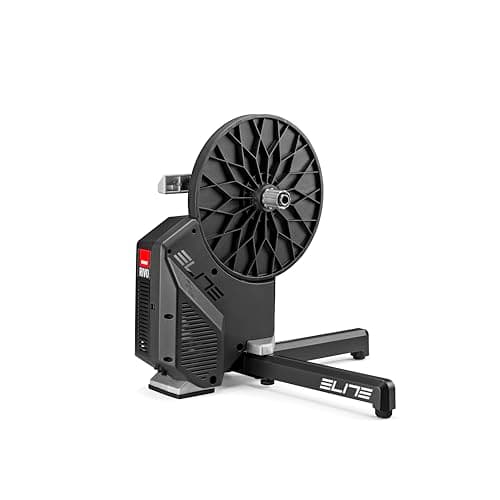
#ad We may earn a commission · Price as of October 22, 2026
A genuinely compelling first direct-drive trainer: WiFi, virtual shifting and a folding frame at a price that undercuts the established value picks — as long as you accept an estimated power figure.
- Type
- Direct drive, electromagnetic
- Claimed accuracy
- ±2.5%, estimated power
- Max resistance
- 2,000 W at 40 km/h
- Max gradient
- 18%
- Flywheel
- 4 kg
- Connectivity
- Bluetooth, WiFi, Zwift protocol
What we'd praise
- Direct drive at a price that usually buys a wheel-on trainer — the biggest single upgrade in indoor cycling
- Onboard WiFi at this tier is genuinely unusual, and it also pulls its own firmware updates
- 10 kg with folding legs and an integrated handle, so it can actually live somewhere other than the middle of a room
- Zwift Cog and Click compatible, so virtual shifting works and you can run a single cog instead of a cassette
- Twelve months of Elite's My E-Training app included
What we'd flag
- Elite lists the power figure as estimated at ±2.5%, not directly measured — the loosest claim in the direct-drive field
- No ANT+ at all, so ANT+ head units and older setups cannot see it
- 4 kg flywheel is light, so road feel is noticeably less settled than a 12 lb or 16 lb unit
- No Race Mode and no Flex Feet, both of which Elite reserves for the pricier Avanti
The Rivo is Elite's attempt to put a real direct-drive trainer at the price where most people are still buying wheel-on units, and on the specification sheet it succeeds. You get electromagnetic resistance, 2,000 W of it at 40 km/h, an 18% simulated gradient ceiling, onboard WiFi, Zwift Cog and Click compatibility, and a 10 kg folding frame with a carry handle. That is a lot of trainer for the money.
The compromise is stated plainly in Elite's own specifications, and we respect them for it: power is estimatedat ±2.5% rather than measured. Whether that matters is the whole review, and the answer is that it depends almost entirely on whether your numbers ever need to be comparable to someone else's. Our accuracy guide is the background reading.
Good questions
Frequently asked questions
Is the Elite Rivo accurate enough for training?
For your own structured training, yes. Elite lists it as estimated power within ±2.5%, which is consistent enough that your zones, intervals and fitness trend all hold together. It is not accurate enough if your numbers need to match another device, such as racing against other riders or following a plan built on an outdoor power meter's FTP.
Does the Elite Rivo work with Zwift?
Yes, over both Bluetooth and WiFi, and it supports Zwift Cog and Click for virtual shifting. That means you can run a single cog instead of a full cassette and shift in software, which removes the drivetrain compatibility question entirely.
Does the Elite Rivo have ANT+?
No. Elite lists communication as Bluetooth, WiFi and the Zwift protocol only. Most modern apps use Bluetooth so this rarely matters, but if you drive your trainer from an ANT+ head unit or run ANT+-only sensors through the same connection, check your setup before buying.
How steep a gradient can the Elite Rivo simulate?
Elite publishes an 18% maximum simulated slope, with a 2,000 W resistance maximum quoted at 40 km/h. Both are below the flagships but well beyond what most riders meet in practice, particularly since most people run a reduced trainer-difficulty setting in Zwift anyway.
How does the Elite Rivo compare to the Wahoo Kickr Core?
The Core measures power more tightly at a claimed ±2%, carries a much heavier 12 lb flywheel for better road feel, and includes ANT+. The Rivo costs less, adds onboard WiFi that the Core does not have, and weighs 10 kg with folding legs. Choose the Core for data quality, the Rivo for price and portability.
Do I need a cassette for the Elite Rivo?
Not necessarily. It is sold in versions with different rear-end setups and supports Zwift Cog and Click, so you can run a single cog and shift virtually rather than fitting a cassette matched to your drivetrain. Check which version you are ordering, since that decides what arrives in the box.
How we sourced this
Keep going
Read these next
- ReviewElite Suito Review
- TrainersElite Suito Review
- TrainersElite Avanti vs Elite Rivo
- TrainersThe Best Smart Trainers for Mountain Bikes
- DealsBlack Friday & Cyber Monday Indoor Cycling Deals 2026
- TrainersThe Best Budget Smart Trainers
- TrainersWahoo Kickr Core Review
- TrainersKickr Core 2 vs Elite Rivo
- TrainersElite Avanti Review
- TrainersThe Quietest Smart Trainers
- GuidesHow Accurate Are Smart Trainers?