Trainer Review
Wahoo Kickr Move Review: What the Movement Actually Fixes
A Kickr v6 that slides. The data is identical, the ride is not, and the price gap is real — here is the honest case for and against paying it.
The Wahoo Kickr Move is the flagship Kickr with one addition: the trainer sits on a rail and travels fore and aft as you pedal. Wahoo did not change the drive unit, the accuracy claim, the resistance ceiling or the connectivity. So this review is not really about specifications — you can read those on the Kickr v6 review and they will all be correct here too. It is about one question: does letting the bike move under you solve a problem worth paying for?
Why a fixed trainer hurts, and what movement changes
Outdoors, a bike is never still. It rocks side to side under your pedal stroke, it moves forward and back through your hands and hips as you accelerate and ease, and the road surface itself constantly changes the loading on your contact points. You do not notice any of this because it is constant and small. What it accomplishes is redistribution: your sit bones never sit on exactly the same square centimeter of saddle for two straight hours.
Bolt the bike to a rigid frame and all of that stops. The saddle contact point becomes fixed. Your hands sit in one spot. Your pelvis stays at one angle. This is precisely why riders who are comfortable for five hours outdoors start shifting around at 70 minutes indoors, and it is why the standard advice for long indoor rides is to stand up periodically — you are manually doing the redistribution the road normally does for you.
The Move's rail gives some of that back. As you push, the trainer travels forward slightly; as you ease, it returns. It is subtle and you stop consciously noticing within a few minutes. What you notice instead is that the discomfort clock runs slower.
| Kickr Move | Kickr v6 | Kickr Core | Tacx Neo 2T | |
|---|---|---|---|---|
| Claimed accuracy | ±1% | ±1% | ±2% | ±1% |
| Max resistance | 2,200 W | 2,200 W | 1,800 W | 2,200 W |
| Max gradient | 20% | 20% | 16% | 25% |
| Flywheel | 16 lb | 16 lb | 12 lb | Virtual (motor-driven) |
| Movement | Fore-aft rail | Axis feet only | None | Frame flex only |
| Onboard WiFi | Yes | Yes | No | No |
| Auto-calibration | Yes | Yes | Spindown | None needed |
| Price band | Top of range | Flagship | Value | Flagship |
Fore-aft is not the same as lateral
This is the specification most likely to disappoint someone who did not read carefully. The Move travels forward and back. It does not lean side to side. A real bike under a hard standing effort rocks laterally as you throw it beneath you, and that motion is a large part of what makes an out-of-the-saddle sprint feel natural.
The Move improves standing efforts, because the bike is no longer fighting your forward surge, but it does not replicate them. If lateral movement is what you are after, the honest answer is that you are looking at a genuinely different category — a smart bike such as the Kickr Bike Shift, or a rocker plate under a conventional trainer. Wahoo does not claim otherwise, and neither should a review.
Living with the rail
The practical costs are footprint and mass. The rail makes the unit longer than a v6, and the whole assembly is heavy. If your trainer lives permanently in a spare room, neither matters. If it gets pushed into a corner between rides, both do — this is not a trainer you slide under a bed. Our apartment setup guide is worth reading before you commit if space is tight.
The other thing the rail changes is where your accessories go. A trainer that moves needs its fan, desk and screen positioned relative to you, not to the trainer, and cables need enough slack to travel. It is a small adjustment, but people who mount a trainer desk tight to the bars on a fixed trainer will need to rethink the geometry.
Everything else is Kickr v6, and that is good
The drive unit is the mature one. Onboard WiFi means the trainer joins your home network and talks to Zwift over IP rather than hopping through a phone, which removes the single most common failure point in indoor cycling — a Bluetooth pairing that silently degrades mid-interval. Auto-calibration means no spindown ritual. The ±1% claimed accuracy is the tightest tolerance in the category, which matters when your numbers have to be comparable to other riders' or to an outdoor power meter, and matters much less for training alone. Our accuracy guide explains why.
Noise is a Kickr v6's noise: quiet for a belt-driven trainer, quieter than anything wheel-on, and dominated by your own drivetrain at endurance pace. The moving rail introduces no new noise source of its own, though a trainer that shifts position is one more reason to put a mat underneath it. We rank the field on noise specifically in the quietest smart trainers.
Who should buy it
Buy the Kickr Move if you ride long indoors — think winter base blocks, three-hour Zwift events, or anyone training for distance rather than crits. Buy it if you have persistent indoor-only saddle or lower-back discomfort, because the mechanism it addresses is exactly the one causing that. Buy it if your setup is permanent, you already know you want a flagship, and the premium over the v6 is not a stretch.
Skip it if your rides are short and structured. A 45-minute threshold session does not last long enough for fixed-position discomfort to become the limiter, and the money is better spent on the room: a serious fan, a screen you enjoy looking at, and a heart-rate strap. Skip it too if what you actually want is lateral movement, because this is not that product. And if the budget is doing real work, the Kickr Coreremains the best value in Wahoo's range by a distance.
Still deciding?
Compare the Kickr Move against the whole fieldThe full reviews
Every pick, in detail
Best trainer for long indoor sessions
Wahoo Kickr Move
9.09.0 out of 10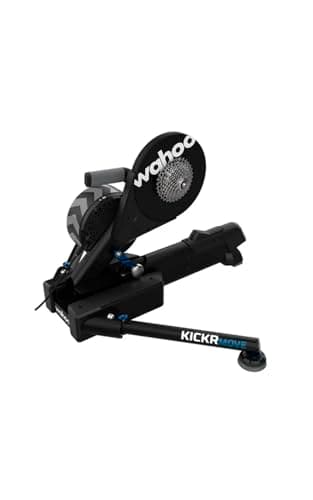
#ad We may earn a commission · Price as of October 21, 2026
A Kickr v6 on a movement rail: the same numbers, a materially more comfortable ride, and a price premium that only makes sense if you ride long.
- Type
- Direct drive, fore-aft movement
- Claimed accuracy
- ±1%
- Max resistance
- 2,200 W
- Max gradient
- 20%
- Flywheel
- 16 lb
- Connectivity
- WiFi, Bluetooth, ANT+ FE-C
- Status
- Discontinued by Wahoo, June 2026 — retailer stock only
What we'd praise
- Fore-aft movement rail lets the bike travel under you instead of pinning your hips in one position
- Same ±1% claimed accuracy, 2,200 W ceiling and 20% gradient as the flagship Kickr v6
- Onboard WiFi and automatic calibration — no spindown, no phone in the data path
- Movement makes long endurance rides noticeably less punishing on the sit bones and lower back
What we'd flag
- Discontinued by Wahoo in June 2026 — remaining retailer stock only, and currently priced above the still-in-production Kickr v6
- Heavy and long — the rail adds a footprint the v6 does not have, which matters in a small room
- Movement is fore-aft only, not the side-to-side lean a real bike does under a sprint
- Adds nothing whatsoever to your power data — you are buying comfort, not accuracy
Read the status line first. Wahoo discontinued the Kickr Move in June 2026 — its own product page says so, directs buyers to the fixed-frame Kickr, and notes that only limited retailer inventory remains. Everything below still describes the machine accurately, because nothing about it has changed; what has changed is that it is now a stock-hunting exercise rather than a catalogue purchase, and the remaining listings sit above the price of the v6 that shares its drive unit.
Strip away the marketing and the Kickr Move is a well-understood machine. It is the flagship Kickr drive unit — the same ±1% claimed accuracy, the same 16 lb flywheel, the same 2,200 W ceiling, the same WiFi and auto-calibration — mounted on a rail that lets the whole trainer slide forward and back a few inches as you ride. Everything that shows up in your ride file is identical to the v6. Everything that shows up in how your body feels after two hours is not.
That makes the buying decision unusually clean, which is refreshing at this price. You are not weighing accuracy against road feel against connectivity. You are answering one question: is fore-aft movement worth the premium over a Kickr v6? We work through that in Kickr Move vs Kickr v6, and the short answer depends almost entirely on how long your indoor rides are.
Good questions
Frequently asked questions
What is the difference between the Kickr Move and the Kickr v6?
The movement rail, and essentially nothing else. Both use the same drive unit with a claimed ±1% accuracy, a 16 lb flywheel, a 2,200 W ceiling, a 20% gradient limit, onboard WiFi and automatic calibration. The Move adds a rail that lets the trainer travel fore and aft as you pedal, which changes comfort rather than data.
Does the Kickr Move move side to side?
No. Its movement is fore-aft only. A real bike rocks laterally under a standing effort, and the Move does not reproduce that. If lateral lean is what you want, you are looking at a smart bike or a rocker plate placed under a conventional trainer instead.
Is the Kickr Move worth the extra money over the Kickr v6?
It depends on ride length. For long endurance sessions the movement meaningfully delays saddle and lower-back discomfort, which is a real quality-of-life gain. For 45-minute interval workouts there is not enough time for fixed-position discomfort to become the limiter, and the v6 delivers identical data for less.
Does the Kickr Move improve power accuracy?
No. The claimed accuracy is ±1%, the same as the Kickr v6, and the movement rail has no effect on measurement at all. You are buying comfort and ride feel, not better numbers, and anyone selling it to you on accuracy grounds is wrong.
How much space does the Kickr Move need?
More than a Kickr v6. The rail makes the unit longer, and the bike itself travels within that footprint, so you need clearance fore and aft as well as to the sides. It is also heavy. Plan for it to live in one place rather than being tidied away between rides.
Do I still need a mat under the Kickr Move?
Yes, arguably more than with a fixed trainer. A mat handles sweat and protects the floor, damps the structure-borne vibration that neighbors below actually hear, and gives the rail a consistent surface to sit on rather than shifting between floorboards and rug edges.
How we sourced this
- Wahoo — KICKR MOVE product page, discontinued as of June 2026 with retailer stock only (manufacturer)
- Wahoo Kickr Move specifications and manual (manufacturer)
- Wahoo Kickr v6 specifications for comparison (manufacturer)
- Trainer movement, road feel and accuracy explainer (DC Rainmaker)
- Zwift supported trainers and connection protocols
Keep going