Trainer Review
Wahoo Kickr v6 Review: What the Flagship Actually Buys
Onboard WiFi, auto-calibration and a claimed ±1%. We read the published specs and did the math on which of those you will feel, and which you are paying for out of habit.

The Wahoo Kickr v6 is the trainer most "best smart trainer" lists put at number one, including ours. It is a direct-drive unit with a claimed ±1% power accuracy, a 16 lb flywheel, 2,200 W of resistance, a 20% simulated gradient ceiling, onboard WiFi and automatic calibration. On paper it wins almost every column. This review is about the part that matters more: which of those numbers you will actually notice from the saddle, and whether a rider upgrading from a mid-tier trainer should spend the difference.
What ±1% actually means
Wahoo claims the v6 measures power within ±1%. At 250 W that is a window of roughly five watts. The Kickr Core's ±2% is about ten watts at the same effort, and a good wheel-on trainer's ±2.5% is about twelve. Framed that way, the accuracy upgrade is real but modest — and for training alone it matters less than people assume, because what drives a training plan is repeatability, not absolute truth. A trainer that reads consistently 8 W high every single ride will still show you getting fitter.
Where the tighter tolerance earns its money is when your numbers have to travel. Racing on Zwift against riders on other hardware, following a plan built on an FTP measured outdoors on a power meter, or comparing a trainer session against an outdoor ride — all of those are comparisons across devices, and that is exactly where a tight tolerance stops being academic. Our accuracy guide goes deeper on the difference between accuracy and repeatability.
Onboard WiFi is the underrated feature
The v6's WiFi is the change most likely to alter your daily experience, and it is the one least visible on a spec sheet. On a Bluetooth trainer, every watt of data hops from the trainer to your phone, tablet or laptop, and that link is the single most common failure point in indoor cycling — dropouts mid-interval, a controllable connection that silently becomes a power-only connection, an ERG session that quietly stops holding.
With WiFi, the trainer joins your home network directly and talks to Zwift over IP. Connections establish faster, hold better at range, and survive a phone doing something else. If you have ever lost an interval to a dropped pairing, this is worth more than the accuracy difference.
| Kickr v6 | Kickr Core | Tacx Neo 2T | |
|---|---|---|---|
| Claimed accuracy | ±1% | ±2% | ±1% |
| Max resistance | 2,200 W | 1,800 W | 2,200 W |
| Max gradient | 20% | 16% | 25% |
| Flywheel | 16 lb | 12 lb | Virtual (motor-driven) |
| Onboard WiFi | Yes | No | No |
| Auto-calibration | Yes | Spindown | Yes, no calibration needed |
| Needs mains power | Yes | Yes | Only for descent simulation |
| Price band | Flagship | Value | Flagship |
Road feel: the flywheel and the feet
Sixteen pounds of steel is the v6's answer to road feel, and it works the way physics says it should. The extra mass over the Core carries momentum further through the dead spot in your stroke, which smooths surges and makes a standing effort feel like accelerating a bike rather than fighting a machine. It is a subtle difference back to back, and a real one over a long ride.
The Axis action feet included with the v6 are the other half. They swap the rigid feet for elastomer ones that allow a small amount of lateral flex, taking the harshest edge off a fixed frame. This is not the same as a genuinely moving trainer or a smart bike, and Wahoo does not claim it is. Think of it as reducing the fixed-frame penalty rather than eliminating it.
Where the v6 is beaten
On the spec sheet, the Tacx Neo 2T matches its accuracy claim, exceeds its gradient ceiling at 25%, needs no calibration at all and can run unplugged for normal riding — a genuinely useful trait if your setup lives somewhere without a convenient socket. It also simulates road surfaces and can drive the pedals on descents. Our Kickr vs Tacx Neo 2T comparison covers that argument properly, and the Neo 2T review covers the trainer in isolation.
On value, it is beaten by its own sibling. The Kickr Core runs the same firmware, the same app and the same ecosystem, gives up WiFi, four pounds of flywheel and one percentage point of claimed accuracy, and costs substantially less. For a rider coming from a wheel-on trainer, the Core is the bigger jump per dollar by a wide margin. That is not a criticism of the v6 so much as an observation about diminishing returns at the top of any category.
Living with it
Setup is straightforward if your drivetrain matches what is fitted. Wahoo typically ships the v6 with an 11-speed cassette pre-installed, which is fine for a lot of bikes and a swap for a 12-speed drivetrain. Check your axle standard against the included adapters before you order — thru-axle bikes are covered, but the specific length matters.
Day to day it asks almost nothing of you. There is no spindown ritual, the firmware updates through the Wahoo app, and the WiFi connection means you can start a Zwift session without holding your phone near the trainer like a divining rod. Add a proper fan and a mat and the setup is complete; those two accessories will change your experience more than any remaining trainer upgrade would.
Two groups of riders get a longer answer elsewhere. Triathletes, for whom ERG Easy Ramp and the WiFi connection are the whole argument, will find the v6 ranked first in the best bike trainers for triathlon. And anyone unsure whether their frame fits should read smart trainer thru-axle compatibility, which lists Wahoo's supported standards and the specific frames it excludes.
Who should buy it
Buy the Kickr v6 if you race on Zwift and want your power to match the field's, if you have fought Bluetooth dropouts and want them gone, if you want the best road feel Wahoo offers in a fixed-frame trainer, or if you are simply buying once and want the top of the range. It is the least compromised trainer in Wahoo's lineup and the one we rank first overall.
Skip it if the budget is doing real work in this decision. The Kickr Core is the smarter buy for most upgrading riders, and the money saved buys a fan, a mat and a year of Zwift — all of which will get you on the bike more often than one percentage point of claimed accuracy ever will.
Still deciding?
Compare the Kickr v6 against the whole fieldFor the head-to-head against the other flagship at this level, see Kickr v6 vs Tacx Neo 3M - same published power figures, opposite engineering, and one of them has onboard WiFi.
The cross-shop worth running before you buy is the Elite Justo, which claims the same ±1% for noticeably less money and beats the v6 on paper for gradient and resistance — Elite Justo vs Wahoo Kickr v6 sets out exactly what you give up to save it.
The full reviews
Every pick, in detail
Best overall smart trainer
Wahoo Kickr v6
9.29.2 out of 10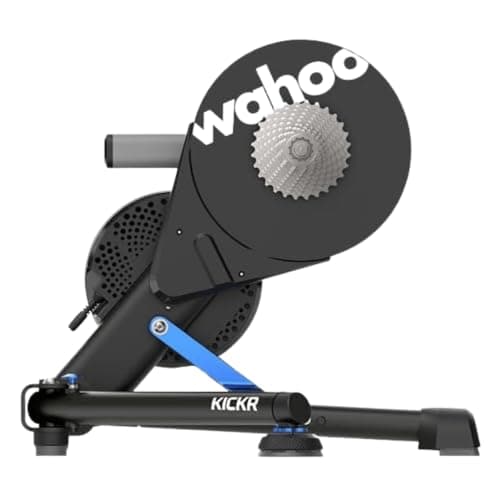
#ad We may earn a commission · Price as of October 22, 2026
The most complete direct-drive trainer Wahoo makes: ±1% claimed accuracy, onboard WiFi and auto-calibration, at a flagship price.
- Type
- Direct drive
- Claimed accuracy
- ±1%
- Max resistance
- 2,200 W
- Max gradient
- 20%
- Flywheel
- 16 lb
- Connectivity
- WiFi, BT, ANT+ FE-C
What we'd praise
- ±1% claimed accuracy, the tightest tolerance in the category
- Onboard WiFi removes the phone or laptop from the connection chain entirely
- 16 lb flywheel plus Axis feet give the most forgiving ride of any fixed-frame Kickr
- Auto-calibration means you never run a spindown again
What we'd flag
- Priced well above the Kickr Core, which delivers most of the same ride
- Fixed frame — no side-to-side movement unless you add the Axis feet's limited flex
- Cassette is usually pre-fitted at 11-speed, so 12-speed drivetrains need a swap
The v6 is the sixth iteration of a trainer that has been refined rather than reinvented, and it shows. The headline changes over the v5 are onboard WiFi and the Axis action feet in the box; everything else is the accumulated result of five previous generations sanding down rough edges. The result is the least fussy flagship trainer on the market: it connects, it calibrates itself, and it holds a target wattage without argument.
It is also expensive, and the honest comparison is not against Tacx or Elite but against Wahoo's own Kickr Core, which runs the same app and firmware for meaningfully less. We settle that in Kickr vs Kickr Core.
Good questions
Frequently asked questions
Is the Wahoo Kickr v6 worth it over the Kickr Core?
It is if you value onboard WiFi, auto-calibration and a claimed ±1% accuracy over ±2%. For a rider upgrading from a wheel-on trainer, the Core delivers roughly 90% of the same experience for meaningfully less, and the saved money buys accessories that improve your riding more.
Does the Kickr v6 need WiFi to work?
No. WiFi is an additional connection option, not a requirement. The v6 still supports Bluetooth and ANT+ FE-C, so it pairs with Zwift, TrainerRoad and head units exactly as previous Kickrs did. WiFi simply removes the phone or laptop from the data path and makes connections more reliable.
Does the Kickr v6 come with a cassette?
Wahoo typically ships the v6 with an 11-speed cassette pre-installed. That works directly with most 11-speed drivetrains; 12-speed riders will usually need to fit a matching cassette. Check the current listing and your own drivetrain before ordering so you can budget for the swap.
Do I still need to calibrate the Kickr v6?
No. The v6 calibrates itself automatically, so there is no spindown routine to remember before a workout. That is one of the practical differences over the Kickr Core, which uses a traditional spindown calibration.
How loud is the Kickr v6?
Because it is a direct-drive trainer, there is no tire on a roller, so the dominant noise is your own drivetrain. It is one of the quieter trainers you can buy under load. A trainer mat helps with vibration transmitted through the floor, which is what neighbors below actually hear.
Is the Kickr v6 better than the Tacx Neo 2T?
They trade blows. Both claim ±1% accuracy. The Neo 2T simulates a higher 25% gradient, needs no calibration, can run unplugged for normal riding and simulates road surfaces. The v6 has onboard WiFi, a physical flywheel many riders prefer and a more mature app ecosystem.
How we sourced this
Keep going