Trainer Review
Tacx Neo 2T Review: The Trainer That Never Needs Calibrating
No flywheel, no belt, no spindown. Garmin's flagship replaces steel with electromagnets — here is what that buys, what it costs, and who should actually want it.
The Tacx Neo 2T is the most unusual trainer in the flagship class, and the one that most rewards understanding how it works. Where nearly every rival brakes a heavy steel flywheel with a magnet, the Neo 2T has no physical flywheel at all. A ring of electromagnets generates resistance directly against the cassette body and simulates the momentum a flywheel would otherwise store. There is no belt to stretch and nothing rubbing on anything, which produces two consequences you will notice on day one: it is remarkably quiet, and it never asks you to calibrate it.
Why no calibration is a bigger deal than it sounds
Most direct-drive trainers use a spindown calibration: you pedal up to a set speed, stop, and let the trainer measure how long the flywheel takes to slow, which tells it about belt tension and internal friction as they change with temperature and age. It takes a minute, and the problem is not the minute — it is that people forget. An uncalibrated trainer drifts, and drift is invisible. You do not get an error message; you get slightly wrong numbers that quietly corrupt a training block.
The Neo 2T removes the failure mode entirely. Because resistance is generated electromagnetically with no friction surfaces to wear and no belt to stretch, there is nothing for a calibration to correct. Garmin's ±1% claim therefore applies on your fiftieth ride the same way it applied on your first. For a rider who wants their numbers to just be right without maintaining them, this is the trainer.
What the virtual flywheel feels like
This is the part that genuinely divides people, and it deserves an honest answer rather than marketing language. A physical flywheel stores kinetic energy: push hard, and it keeps spinning, carrying you through the dead spot in your pedal stroke. The Neo 2T simulates that stored energy electronically, adjusting resistance many times a second to mimic the behavior of a mass that is not there.
Most riders find it convincing, and some find it uncannily good, particularly on rolling terrain where the simulated inertia changes with the gradient in a way a fixed physical flywheel cannot. A minority find it subtly artificial at very low cadences or in big-gear grinds, where a real flywheel's momentum is unmistakable. Neither camp is wrong. If you have the chance to ride one before buying, take it; if not, know that this is a matter of preference rather than quality.
| Tacx Neo 2T | Kickr v6 | Kickr Core | |
|---|---|---|---|
| Claimed accuracy | ±1% | ±1% | ±2% |
| Calibration required | None, ever | Automatic | Spindown |
| Max resistance | 2,200 W | 2,200 W | 1,800 W |
| Max gradient | 25% | 20% | 16% |
| Flywheel | Virtual, electromagnetic | 16 lb steel | 12 lb steel |
| Onboard WiFi | No | Yes | No |
| Works unplugged | Yes, for normal riding | No | No |
| Descent / road-surface simulation | Yes | No | No |
The tricks: descents and road surfaces
Because the Neo 2T's motor can drive as well as resist, it can spin the pedals for you on a downhill in Zwift rather than simply removing resistance. And because it can modulate that force rapidly, it can vibrate to simulate cobbles, gravel and wooden boards when the virtual road surface changes.
Both are legitimately good, and both are the kind of feature you show a friend twice and then stop thinking about. They are not a reason to spend flagship money. The reasons to spend flagship money here are the accuracy that never needs maintaining, the 25% gradient ceiling, and the quiet. Treat the simulation features as a bonus and you will be happy with the purchase; treat them as the justification and you will feel differently in a month.
Running unplugged
The Neo 2T generates its own power from your pedaling, so for ordinary riding it works without being plugged in. That matters more than it sounds if your pain cave is a garage, a shed or a corner of a room where the nearest socket is inconvenient — and it is genuinely useful for travel or race-day warm-ups. Plug it in and you unlock descent simulation and the road-surface effects, plus a slightly more responsive resistance change at the extremes.
Where it loses
No onboard WiFi is the clearest gap against the Kickr v6. Everything still runs over Bluetooth or ANT+, which works fine but keeps your phone or laptop in the data path — the most common source of mid-workout dropouts in indoor cycling. If you have fought connection problems before, that is a real point in Wahoo's favor.
Price is the other. This is a flagship trainer at a flagship price, and the honest question for an upgrading rider is not whether the Neo 2T is better than a Kickr Core — it is — but whether it is better by enough to justify the gap. For most people upgrading from a wheel-on trainer, the answer is no, and the money is better distributed across the room. Our cost guide lays out what each tier really buys.
Two things the 2T has that most trainers do not deserve a note. Its 125 kg rider limit is the highest of any direct-drive trainer we list — bike trainer weight limitscollects every maker's figure — and the question of whether the Neo 3M's motion plates justify the premium over it has its own page: Tacx Neo 2T vs Neo 3M.
Who should buy it
Buy the Neo 2T if you want the tightest accuracy claim available with zero ongoing maintenance, if you ride steep simulated climbs and want headroom past 20%, if your setup has no convenient power outlet, or if quiet is your binding constraint. It is the trainer we would choose for a rider who wants to think about the machine as little as possible.
Choose the Kickr v6instead if you want onboard WiFi and Wahoo's ecosystem, or if you know you prefer the feel of real rotating mass. Choose the Kickr Core if value is the deciding factor. All three are excellent; only one of them never asks you to calibrate it.
Comparing flagships?
See how the Neo 2T ranks against the full fieldThe full reviews
Every pick, in detail
Best road feel and simulation
Garmin Tacx Neo 2T
9.19.1 out of 10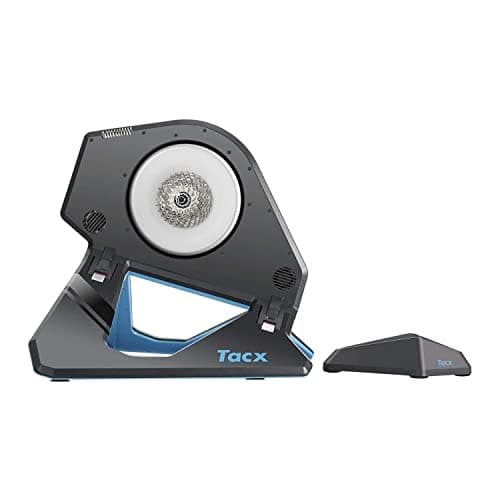
#ad We may earn a commission · Price as of October 21, 2026
The most technically ambitious trainer in the category: no calibration, a 25% gradient ceiling, simulated descents and road surfaces.
- Type
- Direct drive, motor-driven
- Claimed accuracy
- ±1%
- Max resistance
- 2,200 W
- Max gradient
- 25%
- Flywheel
- Virtual — electromagnetic
- Connectivity
- BT, ANT+ FE-C
What we'd praise
- ±1% claimed accuracy with no calibration ever required — nothing to remember, nothing to drift
- Simulates descents by driving the pedals, and simulates road surfaces like cobbles
- Runs unplugged for normal riding, so it works where there is no convenient socket
- No physical flywheel and no drivetrain contact means it is exceptionally quiet
What we'd flag
- Flagship price with no WiFi — connections still run over Bluetooth or ANT+
- Electromagnetic feel divides riders; some prefer the inertia of a heavy steel flywheel
- Needs mains power for descent simulation and the road-feel effects
The Neo 2T takes a different route to the same destination as the Kickr. Instead of a heavy steel flywheel braked by a magnet, it uses a large array of electromagnets to generate resistance directly and to simulate the inertia a flywheel would otherwise provide. Nothing touches anything — no belt, no roller, no friction brake — which is why it needs no calibration and why it is so quiet.
The same architecture enables the party tricks: because the motor can drive as well as resist, it can spin your pedals on a descent and vibrate to simulate cobbles or gravel. Those are genuinely fun, and they are not why you should buy it. Buy it for the ±1% that never needs a spindown. See how it stacks against Wahoo's flagship in Kickr vs Tacx Neo 2T.
Good questions
Frequently asked questions
Does the Tacx Neo 2T need to be calibrated?
No. Because resistance is generated electromagnetically with no belt and no friction surfaces, there is nothing for a calibration to correct. Garmin's ±1% accuracy claim applies without any spindown routine, which removes the most common source of quiet accuracy drift on other trainers.
Can the Tacx Neo 2T run without being plugged in?
Yes, for normal riding. The trainer generates its own power from your pedaling, so it works unplugged in most situations. Mains power is required for descent simulation, where the motor drives the pedals, and for the road-surface vibration effects.
Is the Tacx Neo 2T quieter than a Wahoo Kickr?
Generally yes. With no physical flywheel, no belt and no friction brake, the dominant noise is your own drivetrain. Both are direct-drive trainers and therefore far quieter than any wheel-on unit, but the Neo 2T's architecture removes most of the mechanical noise a trainer can make.
Does the Neo 2T's virtual flywheel feel realistic?
Most riders say yes, and some prefer it to a physical flywheel because the simulated inertia changes with the gradient. A minority notice a subtle artificiality at very low cadences or in big-gear efforts, where real rotating mass is unmistakable. It is a matter of preference rather than quality.
Does the Tacx Neo 2T have WiFi?
No. It connects over Bluetooth and ANT+ FE-C, which covers Zwift, TrainerRoad and bike computers. Onboard WiFi is the clearest advantage the Wahoo Kickr v6 holds over it, because it removes your phone or laptop from the data path and makes dropouts less likely.
Neo 2T or Kickr v6 for Zwift racing?
Both claim ±1% and both are fully controllable, so either is legitimate for racing. The Kickr v6's onboard WiFi makes mid-race connection dropouts less likely, which is the practical argument in its favor. The Neo 2T's advantage is accuracy that holds without any calibration discipline on your part.
How we sourced this
Keep going
Read these next
- TrainersTacx Neo 2T vs Neo 3M
- GuidesBike Trainer Weight Limits, by Model
- DealsBlack Friday & Cyber Monday Indoor Cycling Deals 2026
- TrainersKickr vs Tacx Neo 2T
- TrainersKickr Core vs Tacx Neo 2T
- TrainersWahoo Kickr v6 Review
- TrainersThe Best Smart Trainers, Compared
- TrainersThe Quietest Smart Trainers
- GuidesHow to Calibrate a Smart Trainer