Start Here
Bike Trainer Weight Limits, by Model
Every maker publishes a limit, few publish it where you can find it, and none of them agree on whether it includes the bike. Here is what each one actually says, and what to buy if you are near the line.
Trainer weight limits are the specification that matters most to a meaningful share of riders and that manufacturers bury deepest. Wahoo's figure sits in a support article, not on the product page. Garmin's is in the owner's manual. Elite's is not on its specification pages at all. And when you do find them, they are stated inconsistently: some as "rider weight," some as "user weight," one as "rider and bike." This page collects every figure we could verify from a manufacturer document or, failing that, from a reviewer's published spec box, and says where each one came from. Where a maker publishes nothing, the table says so rather than guessing.
Why the limit exists
A trainer holds a bicycle in a way a road never does. On the road the rear wheel is free to move and the frame's loads are spread through two contact patches that give. On a trainer the rear axle is clamped to a fixed structure, so every out-of-saddle effort, every sprint, every sway becomes a torque on the dropouts, the chainstays and the trainer's own frame. Wahoo's frame compatibility article says as much: the rider is responsible for ensuring the frame can take it, and the company strongly discourages modifying anything to make a bike fit. The weight limit is the point past which the maker will not stand behind that clamp. It is a structural number about the trainer and the bike, not a comment on the rider, which is why the sensible reading is always rider plus bike.
What each maker actually says
Wahoo.The Kickr v6 FAQ lists "Max User Weight: 250 lbs (113 kg)." The Kickr Rollr FAQ lists 250 lb. The Kickr Move product page lists a maximum rider weight of 250 lb / 113 kg. DC Rainmaker's spec box for the Core 2 gives 250 lb / 113 kg, and Wahoo's own compatibility article for the Core refers to "the stated limit of 250lbs / 113 kg" — in the context of e-bikes, where it specifies that the combined weight of rider, bike and battery must be under it. The Kickr Bike Pro is rated to 250 lb / 113 kg on Wahoo's page. In short: every Wahoo, 113 kg, and the one place Wahoo defines the term, it means everything on the trainer.
Garmin / Tacx.The Neo 3M owner's manual specifies a maximum rider weight of 125 kg (275 lb). The Neo 2T is quoted at 125 kg by Zwift Insider's review, which describes it as the largest limit of any trainer on the market at the time, and at 275 lb by Complete Tri.
Elite.The Rivo, Avanti and Tuo specification pages do not list a maximum user weight. DC Rainmaker's spec box for the Rivo lists 110 kg / 242.5 lb, which is the figure we use. We have not found a manufacturer-published figure for the Avanti or the Tuo, so the table leaves them blank rather than assuming the Rivo's number carries over.
Saris.The Fluid2 page states "Maximum Weight (rider and bike): 300 lb." It is the only maker on this page that defines the term on the product page, and the highest figure.
| Trainer | Type | Published limit | Stated as | Source |
|---|---|---|---|---|
| Saris Fluid2 | Wheel-on, fluid | 300 lb / 136 kg | Rider and bike | Saris product page |
| Tacx Neo 3M | Direct drive | 125 kg / 275 lb | Maximum rider weight | Garmin owner's manual |
| Tacx Neo 2T | Direct drive | 125 kg / 275 lb | Rider | Zwift Insider, Complete Tri reviews |
| Wahoo Kickr v6 | Direct drive | 250 lb / 113 kg | Max user weight | Wahoo FAQ |
| Wahoo Kickr Core 2 | Direct drive | 250 lb / 113 kg | Rider, bike and battery (e-bike clause) | Wahoo CORE compatibility article; DC Rainmaker |
| Wahoo Kickr Move | Direct drive, moving | 250 lb / 113 kg | Maximum rider weight | Wahoo product page |
| Wahoo Kickr Rollr | Hybrid wheel-on | 250 lb | Max user weight | Wahoo FAQ |
| Wahoo Kickr Bike Pro | Smart bike | 250 lb / 113 kg | Rider | Wahoo product page |
| Elite Rivo | Direct drive | 110 kg / 242 lb | Max rider weight | DC Rainmaker spec box |
| Elite Avanti | Direct drive | Not published | — | Elite spec page silent |
| Elite Tuo | Wheel-on, smart | Not published | — | Elite spec page silent |
Does the limit include the bike?
Assume yes. Wahoo is the only maker that defines its figure, and it does so as rider plus bike plus battery. Saris says rider and bike. Garmin says "rider weight" without elaboration. Given that the limit is about the load on the clamp, not the person, the conservative reading — and the one that keeps a warranty claim simple — is that a 9 kg road bike or a 14 kg mountain bike counts against it. For a rider at 105 kg on a 10 kg bike, that is the difference between comfortably inside the Wahoo limit and slightly over it.
What to look for if you are near a limit
The number first.A trainer whose published limit you exceed is not a trainer you should buy, whatever the reviews say about its build. The Neo's 125 kg and the Fluid2's 300 lb combined are the two figures that open up the range.
Resistance headroom second.Heavier riders produce more absolute power on simulated climbs — the same gradient at the same speed takes more watts to move more mass — so a trainer's maximum resistance and gradient ceilings arrive sooner. A 16% ceiling is plenty for most riders and a real limit for a 110 kg rider on Zwift's steepest pitches, which is why the Neo's 2,200 W and 25% matter more here than in most roundups. How accurate are smart trainers also explains why accuracy claims are specified as a percentage, which means a heavier rider's absolute error in watts is larger.
Stance and stability third. A wide, heavy, fixed frame resists the sway of out-of-saddle efforts better than folding legs. That is not a published specification, so we cannot rank it, but it is why the direct-drive picks below are the fixed-frame Neo and Core 2 rather than a lighter folding unit.
A mat and a level floor. A trainer mat stops the feet walking and takes vibration out of the floor, and matters more the heavier the load.
The short answer
The trainers to buy near the line
| # | Product | Best for | Score | Price |
|---|---|---|---|---|
| 1 | 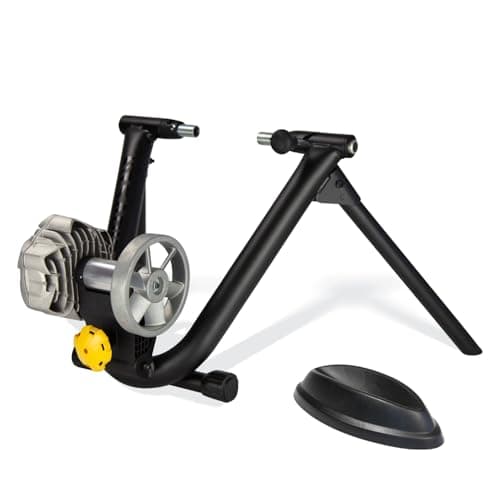 Saris Fluid2 If your combined weight puts you over every direct-drive trainer's limit, this is the trainer whose maker says yes in writing. | Highest published limit: 300 lb, rider and bike | 8.08.0 out of 10 | $129.99 · View on Amazon $249.99Save 48% #ad We may earn a commission · Price as of September 18, 2026 |
| 2 | 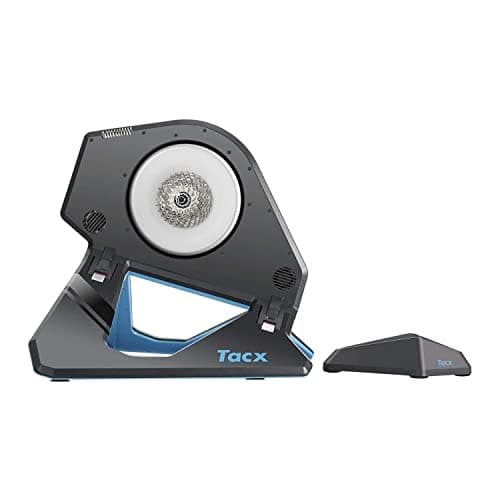 Garmin Tacx Neo 2T The direct-drive trainer to buy at the top of the weight range: the highest limit, the most resistance headroom, and a base that stays put. | Highest direct-drive limit: 125 kg | 9.09.0 out of 10 | $899.99 · View on Amazon $1,099.99Save 18% #ad We may earn a commission · Price as of September 18, 2026 |
| 3 | 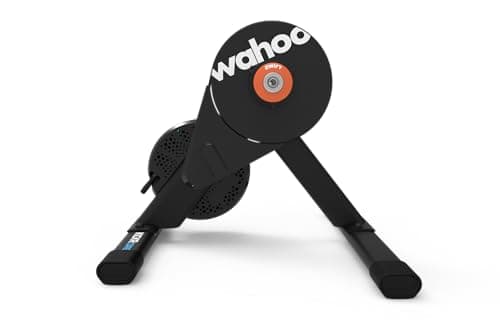 Wahoo Kickr Core 2 For riders comfortably inside 113 kg with the bike, the sensible mid-range trainer — the limit is the same as Wahoo's flagships, so there is no reason to pay more for capacity. | The mid-range pick within 113 kg | 8.78.7 out of 10 | $548.99 · View on Amazon #ad We may earn a commission · Price as of September 18, 2026 |
Wheel-on trainers and the tire question
A wheel-on trainer puts the rider's weight through the rear tire onto a roller, and heavier riders wear tires faster and slip more under hard efforts. Saris and Elite both recommend a trainer tire, and for a heavier rider that recommendation is closer to a requirement: fit one, inflate it to the tire maker's pressure, and set the roller tension carefully. Our trainer tire roundup covers the options, and direct drive vs wheel-on explains why direct drive removes the whole problem.
Smart bikes and e-bikes
Smart bikes carry their own limits — Wahoo's Kickr Bike Pro is 250 lb / 113 kg — and because there is no separate bicycle, the figure is unambiguously the rider. Our Kickr Bike Pro reviewcovers it. For e-bikes on a trainer, Wahoo's rule is the one to follow regardless of brand: supported axle standard, motor off, combined rider-bike-battery weight under the limit, and no objection from the bike's maker to trainer use. An e-bike battery and motor add several kilograms before the rider gets on, which puts many e-bike riders over a 113 kg limit who would be inside it on a road bike.
Over the Wahoo limit?
Read the Tacx Neo 2T review — the 125 kg direct-drive pickThe full reviews
Every pick, in detail
Highest published limit: 300 lb, rider and bike
Saris Fluid2
8.08.0 out of 10$249.99Save 48%
#ad We may earn a commission · Price as of September 18, 2026
If your combined weight puts you over every direct-drive trainer's limit, this is the trainer whose maker says yes in writing.
- Published limit
- 300 lb (136 kg) — rider and bike combined
- Type
- Wheel-on, fluid resistance
- Wheel sizes
- 650b, 700c, 27.5 in to 2.0 in, 29 in to 1.5 in slick
- Dropouts
- 120, 130, 135 mm QR; thru-axle adapter sold separately
- Noise
- 69 dB at 20 mph (Saris)
- Power data
- None in the box
What we'd praise
- Saris states the limit as rider and bike together, and it is still the highest figure on this page
- Wide-stance folding steel frame; the design has been in production for years
- No electronics to fail and nothing to charge
What we'd flag
- Wheel-on: tire wear, roller noise, and no measured power — Zwift needs a speed sensor and estimates
- Thru-axle bikes need the separate adapter
- Fluid resistance cannot be controlled by an app
Saris publishes a maximum weight of 300 lb for rider and bike together on the Fluid2, and that is the highest figure any maker in our registry states. It is a wheel-on fluid trainer, so the trade for that capacity is no app control and no measured power — our turbo trainers roundup covers what that means in practice, and smart trainer vs dumb trainer explains what a speed sensor does and does not add.
Highest direct-drive limit: 125 kg
Garmin Tacx Neo 2T
9.09.0 out of 10$1,099.99Save 18%
#ad We may earn a commission · Price as of September 18, 2026
The direct-drive trainer to buy at the top of the weight range: the highest limit, the most resistance headroom, and a base that stays put.
- Published limit
- 125 kg (275 lb)
- Type
- Direct drive, motor-driven
- Claimed accuracy
- ±1%
- Max resistance
- 2,200 W
- Max gradient
- 25%
- Unit weight
- 21.5 kg
What we'd praise
- 125 kg is the highest limit of any direct-drive trainer we list, and Garmin publishes it in the manual for the 3M as well
- 2,200 W and a 25% ceiling — heavier riders produce more absolute power on climbs, and the Neo has the most headroom
- ±1% measured power, no calibration, and a heavy, wide, low-slung frame that does not walk
What we'd flag
- No cassette in the box, no WiFi, no handle
- The Neo 3M has the same limit and adds motion plates, if that matters, for a large premium
Every Wahoo trainer stops at 113 kg. The Neo 2T and 3M go to 125, which is the number that decides this pick for a lot of riders. The Neo also has the most resistance headroom of any trainer here, which matters because a heavier rider generates more absolute wattage on a simulated climb and can run into a lower-ceiling trainer's limit. Our Tacx Neo 2T review covers the ride, and Neo 2T vs Neo 3M says whether the 3M is worth it.
The mid-range pick within 113 kg
Wahoo Kickr Core 2
8.78.7 out of 10#ad We may earn a commission · Price as of September 18, 2026
For riders comfortably inside 113 kg with the bike, the sensible mid-range trainer — the limit is the same as Wahoo's flagships, so there is no reason to pay more for capacity.
- Published limit
- 250 lb (113 kg)
- Type
- Direct drive, electromagnetic
- Claimed accuracy
- ±2%, measured
- Max resistance
- 1,800 W
- Max gradient
- 16%
- Connectivity
- WiFi, Bluetooth, ANT+ FE-C
What we'd praise
- Wahoo states the limit plainly and, for e-bikes, explicitly as rider plus bike plus battery
- Measured power and WiFi at mid-range money
- Fixed, wide, heavy frame — no folding legs to flex
What we'd flag
- 113 kg is the same limit as every Wahoo, including trainers costing twice as much
- 1,800 W and 16% are the lowest ceilings among the direct-drive trainers here; a heavy, strong rider can find the 16% floor on steep Zwift climbs
The useful thing to know about Wahoo's range is that the weight limit does not rise with price: Core 2, Kickr v6, Kickr Move and Kickr Rollr are all 250 lb / 113 kg. So a rider inside that limit who is choosing a Wahoo should choose on features, and the Core 2 is where measured power and WiFi cost least. Our Kickr Core 2 review covers it; the one caution for a heavy, strong rider is the 16% ceiling, which Kickr v6 vs Kickr Core discusses.
Good questions
Frequently asked questions
What is the weight limit on a Wahoo Kickr?
250 lb (113 kg). Wahoo publishes that figure for the Kickr v6, Kickr Core 2, Kickr Move, Kickr Rollr and Kickr Bike Pro. In its e-bike guidance Wahoo defines the limit as the combined weight of rider, bike and battery.
What is the weight limit on a Tacx Neo?
125 kg (275 lb). Garmin's Neo 3M owner's manual lists a maximum rider weight of 125 kg, and reviews of the Neo 2T quote the same figure. It is the highest limit of any direct-drive trainer in our registry.
Do bike trainer weight limits include the bike?
Assume they do. Saris states its 300 lb Fluid2 limit as rider and bike; Wahoo's e-bike guidance defines its 250 lb limit as rider plus bike plus battery. Garmin says rider weight without elaboration. Because the limit is about the load on the clamped frame, counting the bike is the safe reading.
Which bike trainer has the highest weight limit?
Of the trainers we cover, the Saris Fluid2 at 300 lb (136 kg) for rider and bike combined. Among direct-drive smart trainers, the Tacx Neo 2T and Neo 3M at 125 kg (275 lb).
What is the weight limit on the Elite Rivo?
Elite does not list a maximum user weight on its specification page. DC Rainmaker's spec box for the Rivo gives 110 kg (242 lb), which is the figure we use. We have not found a published figure for the Avanti or Tuo.
What happens if I exceed a trainer's weight limit?
The maker will not stand behind the trainer or your frame. Wahoo's compatibility article states that the rider is responsible for the bike frame and that modifying anything to make a bike fit may void the warranty. Practically, the risks are the trainer's frame flexing or walking under hard efforts and excessive load on the bike's dropouts. Choose a trainer with a higher published limit instead.
Is a heavier rider better off with a direct-drive or wheel-on trainer?
Direct drive, if the published limit allows it. A wheel-on trainer puts the rider's weight through the tire onto a roller, which increases tire wear and slip under hard efforts. Direct drive removes the tire from the equation and the fixed-frame units have a wider, heavier stance. The Saris Fluid2 is the exception that earns its place with a 300 lb combined limit.
How we sourced this
- Wahoo — KICKR v6 (2022) Information & FAQ (Max User Weight 250 lbs / 113 kg)
- Wahoo — Bicycle Frame Compatibility [CORE] (stated limit of 250 lbs / 113 kg, e-bike combined-weight clause, frame responsibility)
- Wahoo — KICKR ROLLR Product Information & FAQ (Max User Weight 250 lb)
- Wahoo — KICKR MOVE product page (Maximum Rider Weight 250 lb / 113 kg)
- Garmin — Tacx NEO 3M Owner's Manual, Specifications (maximum rider weight 125 kg / 275 lb)
- Zwift Insider — Tacx NEO 2T review (125 kg maximum rider weight)
- Complete Tri — Tacx Neo 2T review (275 lb)
- DC Rainmaker — Elite Rivo announcement (Max Rider Weight 110 kg / 242.5 lbs)
- DC Rainmaker — Wahoo Kickr Core 2 in-depth review (250 lbs / 113 kg)
- Saris — Fluid2 trainer (Maximum Weight, rider and bike: 300 lb)
Keep going