Smart Bike Review
Wahoo Kickr Bike Pro Review: The Smart Bike That Tilts
A frame that pitches up 20% and down 15%, Zwift controls built into the hoods, and a price no trainer comes near. Here is what the tilt buys you, and who should actually spend on it.

A smart bike is a complete stationary bicycle with the resistance unit built in. Nothing goes on it and nothing comes off it; you walk into the room, clip in and ride. Wahoo makes two. The Kickr Bike Shift stays level. The Kickr Bike Pro tilts: the entire bike pitches up to a 20% gradient on climbs and down to -15% on descents, following the road in your app in real time.
That movement is the reason the Pro exists and the reason it costs what it does. This review works through what Wahoo actually specifies, what independent testers found when they measured it, where it annoyed them, and the three cheaper ways to get most of what it offers. We have not run our own lab tests on the Pro. Every measured figure below is attributed to the publication that took it, and the specifications come from Wahoo's own product page.
What the Kickr Bike Pro is, and what changed in 2025
The Pro is the third generation of Wahoo's tilting smart bike. The original Kickr Bike was announced in 2019, the V2 added Direct Connect for a wired network connection, and the Pro followed in September 2025. DC Rainmaker's hands-on at launch and Cyclingnews' full review agree on the scope of the change: the touchpoints and controls are new, and the motor, flywheel, tilt mechanism and wattage are carried over.
The new parts are a Fizik Aliante R5 saddle, Fizik Solocush bar tape, a 40 cm handlebar with 16 degrees of flare, reshaped shifter hoods with controller buttons built in, and what Wahoo calls Kickr Bridge, a sensor hub that relays heart rate straps and other sensors through the bike. DC Rainmaker also noted bonded Bluetooth connections, with ANT+ still supported. The price went up slightly over the V2.
From Wahoo's product page, the numbers that matter: ±1% claimed power accuracy, 2,500 W maximum resistance, a simulated grade range of +20% to -15%, a belt drive, connectivity over ANT+, ANT+ FE-C, WiFi, Bluetooth and Direct Connect, and a rider range of 5 ft 0 in to 6 ft 4 in (152 to 193 cm) up to 250 lb (113 kg). It weighs 93 lb, measures 60 by 30 by 46 inches, ships without pedals, and carries a one-year warranty.
| Kickr Bike Pro | Kickr Bike Shift | Kickr v6 + Kickr Climb | Tacx Neo Bike Plus | |
|---|---|---|---|---|
| Your own bike | No | No | Yes | No |
| Claimed accuracy | ±1% | ±1% | ±1% | Within 1% |
| Max resistance | 2,500 W | 2,200 W | 2,200 W | 2,200 W |
| Physical tilt | +20% / -15% | None | +20% / -10% (Climb) | None |
| Shifting | Virtual, programmable | Virtual | Your drivetrain | Virtual, programmable |
| Drivetrain wear | None | None | Chain and cassette | None |
| WiFi | Yes | Yes | Yes (v6) | No |
| Built-in fans | No | No | No | Yes |
| Sold on Amazon US | Yes | Yes | Yes, both | Not found |
| Price band | Highest | High | Flagship trainer plus accessory | Highest |
The tilt: what +20% and -15% actually change
Every smart trainer and smart bike makes a climb harder by adding resistance. The Pro also changes the angle of the bike, so on a steep simulated climb you sit back, your hips open and you pull on the hoods the way you would on a real hill. OutdoorGearLab's reviewers found that the change in geometry engaged climbing muscles in a way a level trainer did not, and Cyclingnews describes the incline actuator as doing the job of a Kickr Climb in a more sophisticated way.
The movement itself is smooth. The5krunner found it moved so smoothly during game rides that the gradient was, if anything, less noticeable than on a real road, while manual incline changes through the Wahoo app responded with a noticeable lag. Descents add a second trick: when you stop pedaling downhill, a motor keeps the flywheel driving forward so the bike feels like it is coasting, and pulling the brake levers slows your avatar, both noted by Cyclingnews and OutdoorGearLab.
Be honest with yourself about what that buys. No manufacturer claims, and no evidence we can cite shows, that riding at a physical gradient produces better fitness than the same workout on a level bike. What it plausibly improves is how specific a climbing session feels and how monotonous a long indoor ride becomes. If most of your training is ERG-mode intervals, where the target wattage is fixed regardless of the road on screen, you will barely notice the tilt at all.
Accuracy: two careful testers, two different answers
Wahoo claims ±1%. Cyclingnews tested that against a set of Favero Assioma Duo power pedals over an easy 90-minute ride and a session of one-minute efforts, and found the Pro inside the claim across the whole power-duration range. The largest deviation was -0.94%, during a 15-second sprint. Cadence, which the bike estimates rather than measures with a sensor, averaged 63.3 rpm against the pedals' 63.4.
The5krunner, over more than 15 hours of rides, reached a different conclusion. Against Favero Assioma Pro RS pedals the Pro read about 2.5% higher, and against Magene P715 dual-sided pedals about 3% higher, when drivetrain losses mean it should, if anything, read slightly lower than a pedal-based meter. The tester was careful to say this could not be proven, but asked Wahoo to add a user power offset. At the time of that review there was no way to run a factory spindown or scale the power figure yourself.
The practical reading: for training indoors, both results mean a consistent number you can build zones around. If you also ride outdoors with a pedal or crank power meter, expect that the two may not agree exactly, and set your zones from one source rather than mixing them. Our guide to smart trainer accuracy explains why two good meters rarely read identically.
Controls, connectivity and the Kickr Bridge
The hoods carry four buttons on each side plus a steering button on the inside of each shifter, laid out like Zwift's own Play controllers. Cyclingnews rated them clearly better than a set of Zwift Play controllers, because they never need charging and cannot slide around the bars. At launch, DC Rainmaker reported that Wahoo says the buttons are free for any platform to use, and expected Rouvy and others to adopt them; Zwift is the obvious target. If you train on something else, check its support for the buttons before counting on them.
Kickr Bridge is the quietly useful change. It collects your heart rate strap and other sensors and passes them through the bike, which, as Cyclingnews points out, frees up Bluetooth connections on devices like Apple TV that only support two at a time. That is the problem our smart trainer connection troubleshooting guide spends most of its time on, solved in hardware.
Race Mode, available only over WiFi, raises the power broadcast rate from once a second to up to ten times a second, according to Wahoo, so sprints register as they happen. Direct Connect gives you a wired network connection for zero dropouts, but the bike has no Ethernet port of its own: the5krunner flagged that you need Wahoo's separately sold adapter. The only onboard display is a small readout of gear and gradient, there is a USB-A charging port, and OutdoorGearLab noted there is nowhere on the bike to rest a phone or tablet, which is the job of a trainer desk.
Fit, sharing and the details that annoy
Wahoo lists five adjustment points (stack, reach, setback, saddle height and frame height), guided by the Wahoo app, plus crank arms with holes for five lengths from 165 to 175 mm. OutdoorGearLab reported a 150 mm Q-factor and a standard 31.8 mm bar and 100 mm stem, so you can fit your own cockpit, and Wahoo says the stock bars accept most clip-on aerobars. Pedals are not included, so budget for a set that matches your cleats.
Sharing is where the Pro is weaker than its price suggests. The bike does not store fit profiles, so every rider change means setting five adjustments by hand, and gearing profiles saved in the Wahoo app have to be switched manually too. The5krunner, sharing it with a smaller rider, resorted to marking each position on strips of masking tape. It works; it is not what you expect at this price.
The same review listed the small things: brake levers made of cheap-feeling plastic, dangling controller wires and an incline lock button that could be better integrated, a single bottle cage, no built-in fans, no side-to-side movement and no road-surface effects. None of them is a reason not to buy. All of them are worth knowing before you do.
Noise, size and getting it into the room
Wahoo describes the Pro as virtually silent. The testers say quiet, not silent. Cyclingnews measured a peak of 69 decibels and a steady 60 to 65 while pedaling, and describes a faint hum that is well below a chain-driven trainer. The5krunner heard an occasional metallic whistle, mostly under acceleration, and was told on asking that it is normal. With no chain, it is still far quieter than a bike on a trainer, which is covered in more depth in the quietest smart trainers.
Size is the real logistics question. At 93 lb and 30 inches wide, it is a two-person carry, and OutdoorGearLab found the width too tight for some of their doorways. Plan the route to the room before it arrives, and unbox it there. Once it is in place, assembly is easy: Cyclingnews had it built and fitted in 15 to 20 minutes, and the stabilizing legs carry transport wheels for small moves. It will still drip sweat onto the floor, so put a mat under it and a proper fan in front of it.
Kickr Bike Pro vs Kickr Bike Shift
This is the decision most smart bike buyers are actually making. On Wahoo's comparison, the Pro adds physical grade changes of +20% to -15%, raises peak resistance from 2,200 to 2,500 W, and weighs 93 lb against the Shift's 79. Both claim ±1% accuracy, both connect over WiFi, Bluetooth, ANT+ and Direct Connect, and both simulate the same gradient range through resistance. Wahoo's list price for the Shift is about half the Pro's.
So the question is almost entirely whether you want the frame to move. 300 W of extra ceiling matters to very few riders, and it matters on sprints, not on climbs. If the tilt is the feature that makes you want to ride, buy the Pro. If what you want is a machine that is always ready and shared easily, the Shift delivers that for far less, and our Kickr Bike Shift review covers it in full.
Kickr Bike Pro vs a Kickr v6 with a Kickr Climb
If the tilt is what you want, there is a cheaper way to get it. Wahoo's Kickr Climb clamps your fork and raises and lowers the front of your bike, up to 20% and down to -10%, and Wahoo lists the Kickr v6 as compatible. Pair the two and you have ±1% claimed accuracy, a 20% physical climb and WiFi, on your own bike, with your own saddle and bars, for less than half the price of the Pro at current prices.
The trade-offs are real. You keep the wheel-off ritual and the drivetrain wear, the descent stops at -10%, and two riders means two bikes. Check compatibility carefully, too: the list on the Climb's own product page covers the v6, v5, the 2017 and 2018 Kickr, the original Kickr Core and the Kickr Snap, and does not include the Kickr Core 2. If you ride indoors a few times a week on one bike, this is the better buy. Start with the Kickr v6 review and the Kickr Climb review.
Kickr Bike Pro vs Tacx Neo Bike Plus and Zwift Ride
The Tacx Neo Bike Plus is the closest rival. Garmin's launch announcement lists power accuracy within 1%, 2,200 W, simulated climbs up to 25%, left and right pedaling analysis, built-in fans, a 4.5-inch display, programmable shifters, five crank lengths, and road-surface effects such as cobbles and gravel when used with the Tacx Training app. The5krunner's comparison notes that it does not physically tilt, and lists its connectivity as Bluetooth and ANT+ FE-C, without WiFi. Cyclingnews calls the two close enough spec for spec that the choice comes down to preference. If you want road-surface feel and built-in fans, it is the Neo; if you want tilt and WiFi, it is the Wahoo.
The Zwift Ride is a different kind of product: an indoor frame that attaches to a compatible smart trainer, with Zwift Play controllers built in. Cyclingnews rates it the cheapest route into a dedicated indoor bike, but found it can feel unstable in high-wattage sprints because of its small central leg, and its accuracy depends on whichever trainer it sits on. The5krunner lists it without gradient tilt. Zwift released a Ride V2 on September 9, 2026, with a more compact frame, a rider range of 4 ft 10 in to 6 ft 6 in and five crank lengths as standard; Zwift's announcement does not mention tilt, and those reviews were written about the original. We could not find either the Neo Bike Plus or the Zwift Ride sold by Amazon in the US when we checked, so neither carries a buy button on this page.
Should Kickr Bike V2 owners upgrade?
Almost certainly not. Cyclingnews concluded that V1 and V2 owners will not see value in upgrading for touchpoint changes alone, particularly since many will already have swapped the saddle and bar tape. DC Rainmaker reported at launch that Wahoo was looking into some form of handlebar upgrade for existing Kickr Bike owners, while noting that Wahoo has a long history of promising Kickr Bike upgrades that never arrived. Do not buy a new bike on the assumption of a retrofit.
Who should buy it
Buy the Kickr Bike Pro if you ride indoors most days of the week, if more than one rider will use it, if you have the space and the route to get it there, and if you specifically want the bike to climb and descend beneath you. For that rider, independent testing supports it as the best smart bike available, and it is the machine that feels most like riding outside.
Skip it if the tilt is a nice-to-have rather than the reason you are shopping: the Kickr Bike Shift does everything else for about half. Skip it if you ride indoors a few times a week on one bike: a Kickr v6 and a Kickr Climb give you the tilt on your own bike for less than half. And skip it if the budget is doing real work, because the best indoor setup is the one you finish, and our pain cave setup guide shows how far the difference in price goes on fans, mats and a screen.
Still deciding between a bike and a trainer?
Read the full smart bike vs smart trainer comparisonThe full reviews
Every pick, in detail
The smart bike that physically tilts
Wahoo Kickr Bike Pro
8.68.6 out of 10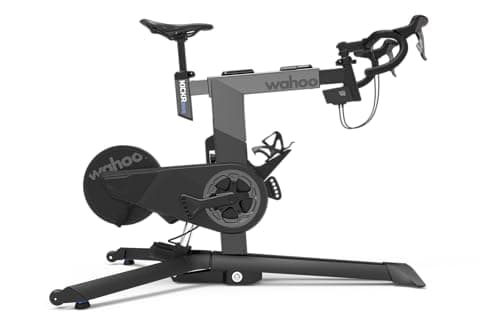
#ad We may earn a commission · Price as of September 17, 2026
The most complete indoor bike you can buy and the least necessary one: brilliant if you ride indoors most days and want the tilt, hard to justify over the Shift if you do not.
- Type
- Smart bike, no bike required
- Claimed accuracy
- ±1%
- Max resistance
- 2,500 W
- Physical tilt
- +20% climb, -15% descent
- Connectivity
- WiFi, Bluetooth, ANT+ FE-C, Direct Connect
- Rider range
- 5 ft 0 in to 6 ft 4 in, up to 113 kg (250 lb)
- Cranks
- 165, 167.5, 170, 172.5 and 175 mm
- Unit weight
- 93 lb
What we'd praise
- The frame itself pitches up to 20% and down to -15%, so a climb changes your position and not just the resistance
- Zwift-style controller buttons are built into the hoods, with no batteries to charge and nothing to slip on the bars
- Built-in Kickr Bridge relays heart rate and other sensors, which frees up Bluetooth connections on devices such as Apple TV
- Cyclingnews measured it within Wahoo's ±1% claim against Favero Assioma Duo pedals, from sprints to 60-minute efforts
- Five-point fit plus five crank lengths, and a standard 31.8 mm bar and stem you can swap for your own
- Motor-driven coasting on descents, Race Mode over WiFi and working brake levers make it the most bike-like machine in the category
What we'd flag
- It costs about twice as much as Wahoo's own Kickr Bike Shift, and the tilting frame is the headline difference
- The5krunner found it reading roughly 2.5 to 3% higher than two sets of dual-sided power pedals, and there is no user power offset or spindown
- No saved fit profiles, so sharing it between riders means re-setting five adjustments by hand each time
- Not silent: a faint hum in Cyclingnews' testing, and an occasional metallic whistle under acceleration in the5krunner's
- 93 lb and 30 in wide, so getting it into the room is a two-person job and some doorways will be tight
- No built-in Ethernet port (Direct Connect needs an adapter), no side-to-side movement, no road-surface effects and plastic brake levers
- Pedals are not included
The Kickr Bike Pro is the 2025 update of Wahoo's original tilting smart bike, and the update is about the places your body touches rather than the machine underneath. Cyclingnews notes that the frame, internals and electronics carry over from the Kickr Bike V2. What is new is a Fizik Aliante R5 saddle, Fizik Solocush tape on a redesigned flared handlebar, controller buttons built into the hoods, and a built-in sensor bridge.
The feature that defines it is unchanged: the whole bike pitches nose-up on climbs and nose-down on descents. Everything else on this page is really a question about whether that movement is worth what it costs you over a Kickr Bike Shift, which keeps the virtual shifting and the ready-to-ride convenience but stays level.
Best alternative if you want a smart bike without the tilt
Wahoo Kickr Bike Shift
8.78.7 out of 10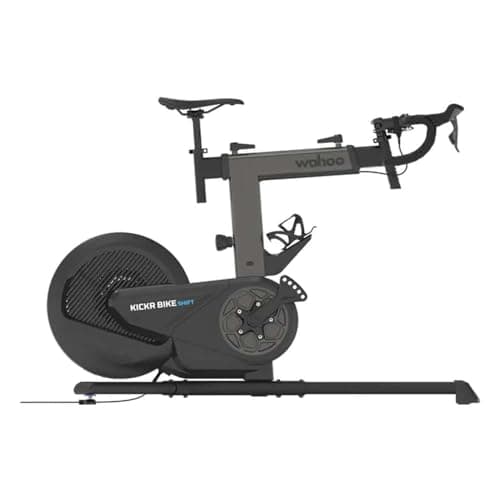
$2,699.99Save 26%
#ad We may earn a commission · Price as of September 17, 2026
The smart bike most riders who want a smart bike should actually buy: the convenience and the claimed accuracy of the Pro, without paying for the frame that moves.
- Type
- Smart bike, no bike required
- Claimed accuracy
- ±1%
- Max resistance
- 2,200 W
- Physical tilt
- None, fixed frame
- Simulated gradient
- +20% / -15% through resistance
- Unit weight
- 79 lb
What we'd praise
- The same walk-up-and-ride convenience and virtual shifting for about half the Pro's price at Wahoo's list prices
- Wahoo lists the same ±1% claimed accuracy and the same simulated gradient range as the Pro
- 14 lb lighter than the Pro, which matters on stairs
- Nothing to wear out: no chain, no cassette, no drivetrain to clean
What we'd flag
- No physical tilt, which is the Pro's headline feature
- Lower 2,200 W ceiling, although that is a limit very few riders will ever reach
- Wahoo lists fit adjustment and gearing among the differences from the Pro, so check the details against your own fit
- Still a large, permanent, single-purpose machine at a price well above a flagship trainer
On Wahoo's own comparison, the Shift and the Pro share a claimed ±1% accuracy, WiFi, Bluetooth, ANT+ and Direct Connect, and a simulated gradient of +20% to -15%. What the Shift gives up is physical grade change, 300 W of peak resistance and some of the Pro's adjustment and gearing options.
That is a sensible place to draw the line. The tilt is immersion. The convenience is what gets you on the bike more often. If the second is why you want a smart bike, our full Kickr Bike Shift review is the page to read next.
Best value route to the same numbers, on your own bike
Wahoo Kickr v6
9.29.2 out of 10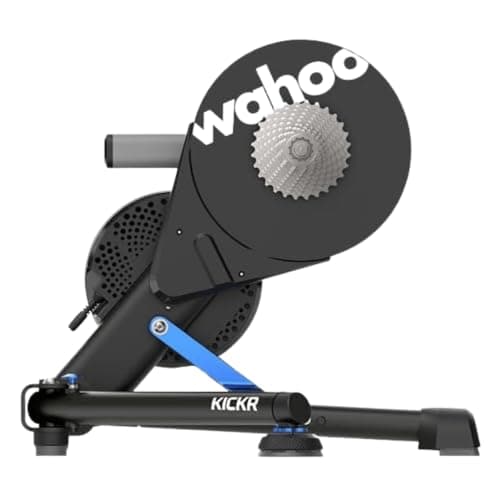
#ad We may earn a commission · Price as of September 17, 2026
The trainer the Kickr Bike Pro has to justify itself against: the same claimed accuracy on the bike you already own, for a fraction of the money.
- Type
- Direct drive smart trainer
- Claimed accuracy
- ±1%
- Max resistance
- 2,200 W
- Max gradient
- 20%
- Flywheel
- 16 lb
- Connectivity
- WiFi, Bluetooth, ANT+ FE-C, Direct Connect
What we'd praise
- Wahoo claims the same ±1% accuracy as the Kickr Bike Pro
- Your own bike means your exact fit, saddle and bars, which no adjustable frame can fully copy
- WiFi and Race Mode, the same connection features the Pro relies on
- Compatible with the Kickr Climb, so you can add physical tilt later
What we'd flag
- The rear wheel comes off every time, and your chain and cassette wear indoors
- The drivetrain is audible in a way a belt-driven smart bike is not
- Sharing between riders means sharing bikes, or swapping them
- No tilt on its own: that takes a Kickr Climb as a second purchase
Wahoo lists the Kickr v6 at ±1% claimed accuracy, 2,200 W and a 20% simulated incline, with a 16 lb flywheel, WiFi and Race Mode. On measurement, that is the Kickr Bike Pro without the bike.
What it asks in return is the ritual every trainer owner knows: wheel off, bike on, drivetrain wear and chain noise. The full breakdown is in our Kickr v6 review, and whether that ritual is worth a smart bike's price is the whole subject of smart bike vs smart trainer.
The tilt without the smart bike
Wahoo Kickr Climb
8.28.2 out of 10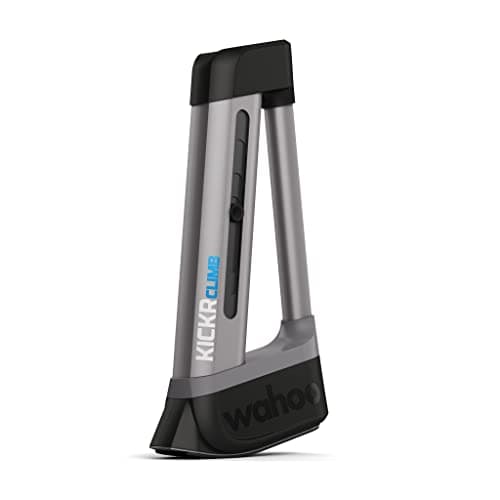
$749.99Save 24%
#ad We may earn a commission · Price as of September 17, 2026
If the tilt is what draws you to the Kickr Bike Pro, this is the cheaper way to get it, on the bike you already ride.
- Type
- Gradient simulator, replaces the front wheel
- Physical grade
- +20% climb, -10% descent
- Compatible trainers
- Kickr v6, v5, 2018 and 2017, Kickr Core (original), Kickr Snap
- Axles
- Quick release, 12x100, 15x100, 15x110
- Control
- Automatic from the app, or manual remote
- Role here
- Adds tilt to a Kickr v6
What we'd praise
- Gives a Kickr v6 the same +20% physical climb as the Kickr Bike Pro
- A Kickr v6 plus a Climb together cost less than half of a Kickr Bike Pro at current prices
- Keeps your own bike, fit and contact points in the tilting position
- Replaces a front wheel riser block, so the bike sits properly level
What we'd flag
- Descends only to -10%, against the Pro's -15%
- Works exclusively with the Wahoo trainers on its compatibility list; the Kickr Core 2 is not on the list Wahoo publishes on the Climb page
- Adds no watts, no accuracy and no data, only position
- Takes more floor space in front of the trainer, and a desk placed too close will foul the bars at full climb
The Climb clamps your fork into a motorized carriage that raises and lowers the front of the bike to match the gradient in your app. Wahoo lists up to 20% of incline and -10% of decline, and its compatibility list on the Climb's product page includes the Kickr v6.
It is the most direct buyer-first answer to the Kickr Bike Pro: the same climbing position, for less than half the money, at the cost of the wheel-off ritual and a shallower descent. Our Kickr Climb review covers where it belongs on your shopping list, which is after the fan and the mat.
Good questions
Frequently asked questions
Does the Wahoo Kickr Bike Pro actually tilt?
Yes. The whole bike physically pitches up to a 20% gradient on climbs and down to -15% on descents, following the road in apps such as Zwift in real time. Wahoo's cheaper Kickr Bike Shift simulates the same gradient range through resistance only and its frame stays level.
What changed between the Kickr Bike V2 and the Kickr Bike Pro?
The touchpoints and controls. The Pro adds a Fizik Aliante R5 saddle, Fizik Solocush bar tape, a 40 cm handlebar with 16 degrees of flare, controller buttons built into the hoods, a Kickr Bridge sensor hub and bonded Bluetooth connections. Cyclingnews and DC Rainmaker both report that the motor, flywheel, tilt mechanism and 2,500 W ceiling are carried over from the V2.
Is the Wahoo Kickr Bike Pro accurate?
Wahoo claims plus or minus 1%. Cyclingnews measured it inside that claim against Favero Assioma Duo pedals, with a largest deviation of -0.94% during a 15-second sprint. The5krunner found it reading about 2.5 to 3% higher than two sets of dual-sided power pedals over 15-plus hours, and noted there is no user power offset or spindown to adjust it.
Kickr Bike Pro or Kickr Bike Shift?
Choose the Pro only if you want the physical tilt. Both claim plus or minus 1% accuracy, both offer virtual shifting and WiFi, and both simulate +20% to -15% through resistance. The Pro adds the moving frame, 2,500 W instead of 2,200 W, and 14 lb of weight, and Wahoo lists it at about twice the Shift's price.
Can I get physical tilt without buying a smart bike?
Yes. The Wahoo Kickr Climb replaces your front wheel and raises and lowers the bike from +20% to -10%. Wahoo lists it as compatible with the Kickr v6, and a v6 plus a Climb costs less than half of a Kickr Bike Pro. You keep the wheel-off ritual and drivetrain wear, but you ride your own bike.
Does the Kickr Bike Pro come with pedals?
No. Wahoo ships it without pedals, so you fit the pedals that match your cleats. The crank arms offer five lengths from 165 to 175 mm.
Can two riders share a Kickr Bike Pro?
Yes. Wahoo rates it for riders from 5 ft 0 in to 6 ft 4 in and up to 250 lb, with five fit adjustments. It does not store fit profiles, though, so each rider change means resetting the adjustments by hand; the5krunner marked positions on masking tape to speed it up.
How loud is the Wahoo Kickr Bike Pro?
Quiet, but not silent. Cyclingnews measured 60 to 65 decibels while pedaling steadily and a peak of 69, describing a faint hum. The5krunner heard an occasional metallic whistle under acceleration, which the tester was told is normal. With a belt drive and no chain, it is quieter than a bike on a direct-drive trainer.
How we sourced this
- Wahoo KICKR BIKE PRO product page and technical specifications (manufacturer)
- Wahoo KICKR CLIMB product page and compatible trainers (manufacturer)
- Wahoo KICKR v6 product page and specifications (manufacturer)
- Wahoo KICKR Bike Pro hands-on, DC Rainmaker (September 2025)
- Wahoo Kickr Bike Pro review, Cyclingnews
- Wahoo KICKR Bike PRO review, the5krunner
- Wahoo KICKR Bike Pro review, OutdoorGearLab
- Tacx NEO Bike Plus launch announcement (Garmin)
- Zwift Ride V2 announcement, Zwift newsroom (September 2026)
Keep going