Smart Bike Review
Wahoo Kickr Bike Shift Review: The Smart Bike That Makes the Case
Virtual shifting, no chain, and a fit you set once. Wahoo's more attainable smart bike drops the tilting frame and keeps the parts that change your daily riding.

A smart bike is a complete stationary bicycle with the resistance unit built in. No road bike goes on it, no wheel comes off, and on the Kickr Bike Shift there is no chain at all. Wahoo positions it below the tilting Kickr Bike Pro, and the gap between the two models is almost entirely about frame movement rather than measurement. This review covers what the Shift actually does, what it costs you against a flagship trainer that claims the same accuracy, and the specific riders for whom it is the right purchase.
Virtual shifting: the feature that changes the machine
There is no chain, no cassette and no derailleur. Shift buttons tell the resistance unit to change load in a step that mimics a gear change, and Wahoo lets you configure what that virtual drivetrain looks like — chainring sizes, cassette range, number of gears. You can set it to mirror the bike you race outdoors so that indoor and outdoor gear selection feel the same, or give yourself a wider range than any real drivetrain offers.
Three consequences follow, and all three are more significant than they sound. Shifts are instant and never mis-index. There is nothing to clean or lubricate, ever. And the whole machine is dramatically quieter than a bike on a direct-drive trainer, because on a trainer the chain under load is the noise. If you ride early while a household sleeps, that last one alone changes what hours are available to you.
Fit: five points, no tools
The Shift adjusts saddle height, saddle setback, handlebar reach, handlebar height and crank length, all without tools. That combination is what makes a smart bike shareable — two riders of noticeably different sizes can hand it back and forth in under a minute, which is impossible with a trainer unless you own two bikes.
Be clear about the limit, though. Adjustment ranges reproduce your position, not your contact points. The saddle and bars belong to the machine, and if you have spent years dialing in a specific saddle and bar shape, riding something else for your hardest indoor efforts is a real change. Swapping in your own saddle helps and is worth doing. Riders training specifically for outdoor events often prefer a trainer for exactly this reason — we cover the trade-off properly in smart bike vs smart trainer.
| Kickr Bike Shift | Kickr Bike Pro | Kickr v6 | |
|---|---|---|---|
| Type | Smart bike | Smart bike | Trainer, your bike |
| Claimed accuracy | ±1% | ±1% | ±1% |
| Max resistance | 2,200 W | 2,500 W | 2,200 W |
| Max gradient | 20% | 20% | 20% |
| Tilting incline frame | No | Yes | No |
| Virtual shifting | Yes | Yes | No — your drivetrain |
| Drivetrain wear | None | None | Yes |
| Fit adjustment | Five-point, tool-free | Five-point, tool-free | Your own bike |
| Price band | High | Highest | Flagship trainer |
What you give up against the Kickr Bike Pro
The headline omission is the tilting frame. On the Pro, the whole bike pitches nose-up on climbs and nose-down on descents, shifting your weight the way a real gradient does. It is the most convincing simulation feature in indoor cycling, and it is also the single most expensive thing in the machine. The Pro also raises the resistance ceiling to 2,500 W, and our Kickr Bike Pro review covers what independent testers found when they rode it.
The Shift keeps everything that measures and controls, and drops the thing that moves. That is a defensible split: incline simulation is immersion rather than training benefit, and no manufacturer claims it produces better adaptation. If you want it, you know who you are. If you are unsure, you do not want it enough to pay for it.
Living with it
Assembly is a genuine job — this is a large, heavy object that arrives in a large, heavy box, and it is not moving again once it is placed. Think of siting it the way you would think about siting a treadmill. After that, the daily experience is the whole point: walk in, get on, ride. Nothing to pair with a phone if you are on a supported connection, nothing to calibrate, no wheel in a corner, no bike to put back together before Saturday.
You will still want the rest of the room. A smart bike does nothing about heat, so a proper fan is not optional, and a mat protects your floor from sweat even without a drivetrain to worry about. Our pain cave setup guide covers how the pieces fit around a permanent machine.
The honest value question
The Shift claims the same ±1% accuracy, the same 2,200 W ceiling and the same 20% gradient as a Kickr v6 that costs a fraction as much. Nothing about the smart bike makes you fitter. So the entire price gap buys convenience, sharing and silence.
That can be a completely rational purchase. If you ride indoors four times a week for six months and the setup friction currently costs you one session a week, the machine buys you roughly twenty-four extra rides a winter. If you ride indoors when it rains, it buys you nothing you will notice. The arithmetic is personal, and it is worth doing honestly before clicking buy. Our cost guide puts the tiers side by side.
Who should buy it
Buy the Kickr Bike Shift if indoor riding is a habit, if the machine is shared between riders, if noise constrains when you can train, or if you want your road bike to stay built and clean all winter. In those situations it is the best-value entry into a category that usually is not good value at all.
Skip it if you ride indoors occasionally, if you are training toward outdoor events where fit specificity matters, or if the budget is doing real work. In all three cases, put the money into a flagship smart trainer and the room around it and you will ride more, not less.
If the category is right but this price is not, there is now a middle option: the Zwift Ride bundles a frame with a Kickr Core 2 for roughly a third of flagship smart bike money, trading the belt drive and the ±1% claim for a chain and ±2%. We run that decision properly in Zwift Ride vs Wahoo Kickr Bike Shift, including the two specifications where the cheaper bike wins outright. Our best smart bikes roundup puts all five current options side by side.
Still weighing the category?
Read the full smart bike vs smart trainer comparisonThe full reviews
Every pick, in detail
Best smart bike for most riders
Wahoo Kickr Bike Shift
8.78.7 out of 10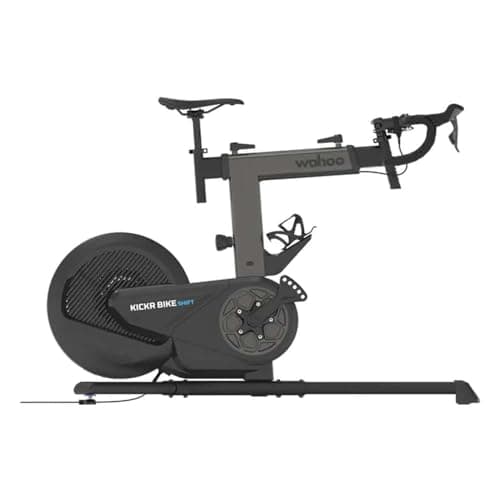
$2,699.99Save 12%
#ad We may earn a commission · Price as of October 21, 2026
The smart bike that makes the category make sense: flagship power accuracy, virtual shifting and a fit you dial once and forget.
- Type
- Smart bike, no bike required
- Claimed accuracy
- ±1%
- Max resistance
- 2,200 W
- Max gradient
- 20%
- Drivetrain
- Virtual shifting, configurable
- Fit adjustment
- Five points, tool-free
What we'd praise
- Walk up and ride — no wheel to remove, no bike to strip, nothing to set up between sessions
- Virtual shifting means no chain, no cassette wear and almost no mechanical noise
- Five-point tool-free fit adjustment makes it genuinely shareable between riders
- Configurable virtual drivetrain lets you mirror the gearing of the bike you race on
What we'd flag
- Costs several times a flagship smart trainer with the same claimed accuracy
- Fixed frame — no tilting incline, which is the Kickr Bike Pro's headline feature
- It is furniture: heavy, permanent, and single-purpose
The Kickr Bike Shift is Wahoo's answer to a fair criticism of smart bikes — that they cost too much for what they add. It keeps the parts that define the category (no bike required, virtual shifting, tool-free fit adjustment, ±1% claimed accuracy) and drops the most expensive part of the flagship Kickr Bike Pro: the tilting frame that simulates incline.
What remains is the version of the argument that holds up. If you ride indoors often enough that the setup ritual costs you sessions, or you share the machine with another rider, this is where the category stops being an indulgence. If neither applies, a Kickr v6 matches the numbers for a fraction of the money.
Good questions
Frequently asked questions
Does the Kickr Bike Shift have a chain?
No. It uses virtual shifting, where buttons tell the resistance unit to change load in steps that mimic gear changes. There is no chain, cassette or derailleur, so nothing wears out, nothing needs lubricating, and the machine runs far quieter than a bike on a direct-drive trainer.
What is the difference between the Kickr Bike Shift and the Kickr Bike Pro?
The Pro adds a tilting frame that pitches the bike nose-up on climbs and nose-down on descents. Both models offer virtual shifting, tool-free five-point fit adjustment and a claimed ±1% power accuracy. The Pro also raises peak resistance from 2,200 W to 2,500 W, so the difference is immersion, a higher ceiling and price rather than measurement.
Can I set the Kickr Bike Shift to match my road bike's gearing?
Yes. The virtual drivetrain is configurable, so you can set chainring sizes, cassette range and the number of gears to mirror the bike you ride outdoors. That keeps gear selection consistent between indoor and outdoor riding, or lets you build a wider range than any real drivetrain offers.
Is a Kickr Bike Shift more accurate than a Kickr v6?
No. Both claim ±1% power accuracy and both top out at 2,200 W and a 20% simulated gradient. The smart bike's advantages are convenience, shareability and near-silent operation, not measurement quality, and no manufacturer claims it produces better training adaptation.
Can two riders of different sizes share it?
Yes, and it is one of the strongest reasons to buy one. Saddle height, saddle setback, handlebar reach, handlebar height and crank length all adjust without tools, so handing the machine between riders of different sizes takes under a minute rather than requiring a second bike.
Do I still need a fan and a mat with a smart bike?
Yes to the fan, and usually yes to the mat. A smart bike does nothing about heat, and indoor riding without airflow is the fastest way to cut a session short. A mat protects your floor from sweat and reduces vibration transmitted downward, even though there is no drivetrain to drip onto it.
How we sourced this
Keep going