Trainers
The Best Bike Trainers Under $200, Ranked
Under $200 you cannot buy direct drive, and only one trainer here lets an app set the resistance. That single fact decides this ranking — and it decides whether the trainer you buy will actually get used.
The short answer
Quick picks
| # | Product | Best for | Score | Price |
|---|---|---|---|---|
| 1 | 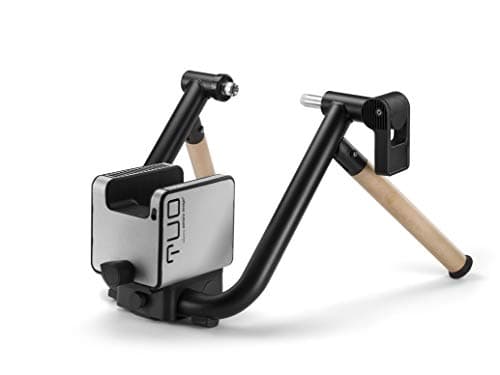 Elite Tuo Best for the rider who wants Zwift to control the resistance — the only trainer in this band that does, and the reason to spend the whole $200. | Best overall under $200 | 7.87.8 out of 10 | $162.49 · View on Amazon #ad We may earn a commission · Price as of November 22, 2026 |
| 2 | 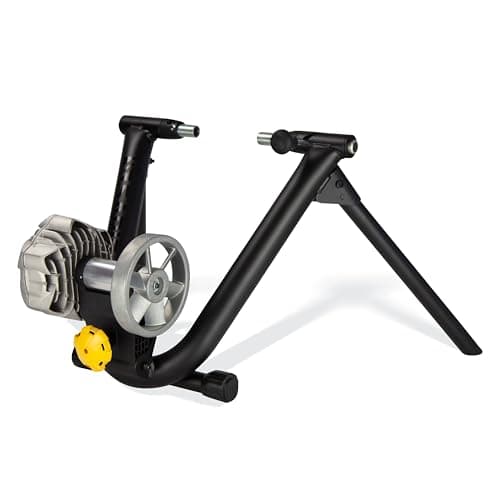 Saris Fluid2 Budget pick: the toughest, cheapest, longest-lived way to ride indoors, as long as you accept that no app can change what it does. | Budget pick: toughest frame, highest published limit | 7.57.5 out of 10 | |
| 3 | 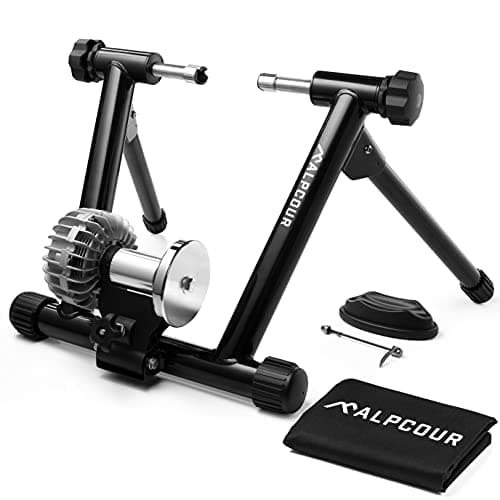 Alpcour Fluid Bike Trainer Stand Best for the rider whose trainer has to disappear between sessions — a fluid trainer on a genuinely foldable frame. | Best for a trainer that folds away completely | 6.46.4 out of 10 | $189.95 · View on Amazon #ad We may earn a commission · Price as of November 22, 2026 |
| 4 | 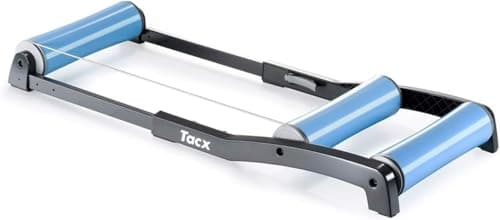 Tacx Antares Best for the rider who wants to pedal better rather than harder — real road feel, zero app integration. | Best road feel and bike-handling work | 6.66.6 out of 10 | $199.99 · View on Amazon #ad We may earn a commission · Price as of November 22, 2026 |
| 5 | 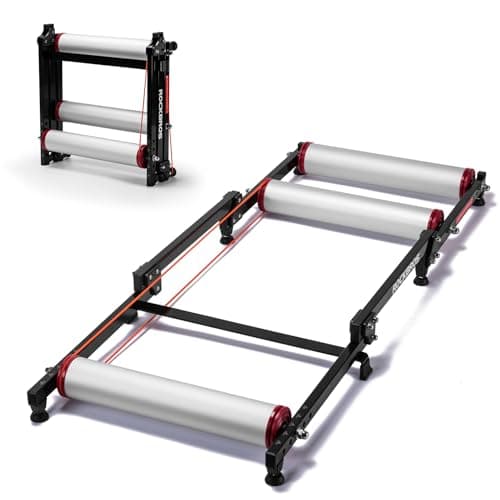 ROCKBROS Bike Rollers The cheap way to test whether rollers are for you — resistance the Antares lacks, documentation the Antares has. | Cheapest rollers with any resistance at all | 5.95.9 out of 10 | $165.99 · View on Amazon #ad We may earn a commission · Price as of November 22, 2026 |
Two hundred dollars is a real constraint in indoor cycling, and it is worth being blunt about what it rules out before we rank anything. It rules out direct drive: every trainer that removes your rear wheel and takes a cassette starts well above this band, which means tire wear, tire noise and a pressure routine are part of the deal whatever you buy here. It rules out measured power on all but one pick. And it rules out the ±1% accuracy figures that make indoor watts comparable to anybody else's.
What it does not rule out is useful training. A rider on a $150 trainer who shows up four times a week will get fitter than a rider who spent $900 and rides twice a month. So this page ranks on the things that decide whether the trainer gets used, not on the things that look good in a specification table.
The one specification that matters most under $200
Can an app control the resistance? That is the question, and in this band the answer is almost always no. A controllable trainer receives a command from Zwift and changes how hard it is to pedal: the climb gets heavier, the descent eases off, and an ERG workout holds a target wattage regardless of your gear or cadence. A non-controllable trainer — fluid, magnetic or roller — has a fixed resistance curve set by wheel speed, and nothing can alter it. The gradient on screen is decoration.
That difference changes the whole experience. On a controllable trainer, Zwift is a ride. On a non-controllable one it is a video with a number on it, and you create the intervals yourself by changing gear and watching a clock. Plenty of people train happily that way for years. But if you are buying an indoor trainer because of Zwift, it is the single thing worth spending the top of your budget on — which is why the Elite Tuo is ranked first here despite being the most expensive pick and having the lowest ceilings.
The second question: what will Zwift actually see?
A trainer that reports power is a trainer Zwift can use on its own. Only the Tuo does that here. Every other pick on this page produces no data at all, which means that before you can ride Zwift you need to add a sensor — and the choice of sensor changes the cost of the whole setup.
The cheap route is a speed sensor: Zwift reads wheel speed and estimates your watts from the trainer's published power curve. That estimate is consistent enough to train against and is not comparable to another rider's numbers. It also only works properly if the trainer's curve is in Zwift's list, and if you keep tire pressure and roller tension the same every ride. The expensive route is a power meter, which measures properly and costs more than every trainer on this page.
So the honest arithmetic is this: a $140 fluid trainer plus a speed sensor lands close to the price of the Tuo, and the Tuo does more. The fluid trainers earn their place on toughness, storage and weight limits rather than on being cheaper once you have a working Zwift setup.
How we ranked them
App control first, because it is the only capability in this band that cannot be added later with an accessory. Published numbers second — we rank what a maker actually states and refuse to score what it does not, which is why two products here sit below cheaper rivals purely because their makers publish nothing citable. Then what it costs to get riding: a trainer that needs a sensor is not a $140 trainer. Then durability and storage, which is where the steel-framed fluid trainers quietly win.
We have not bench-tested these units. Every figure on this page is the manufacturer's own published specification and is labeled as such, and where a maker publishes nothing we say so rather than estimating. Our how we review page explains the method.
| Trainer | Type | App-controlled? | Power data | Published rider limit |
|---|---|---|---|---|
| Elite Tuo | Wheel-on, controllable | Yes | Yes, ±2.5% claimed | Not published |
| Saris Fluid2 | Wheel-on, fluid | No | None — add a sensor | 300 lb, rider and bike |
| Alpcour Fluid Trainer Stand | Wheel-on, fluid | No | None — add a sensor | Not published |
| Tacx Antares | Rollers, no resistance unit | No | None | Not published |
| ROCKBROS Bike Rollers | Rollers with resistance | No | None | Not published |
Noise is the hidden cost of every trainer in this band
Direct-drive trainers are quiet because the loudest part of a wheel-on setup is not the resistance unit — it is rubber pressed against a steel roller. Every trainer on this page keeps the tire, so every one of them is louder than a trainer costing three times as much. Saris is the only maker here that publishes a figure: 69 dB at 20 mph for the Fluid2.
If the trainer is going in an apartment or a shared house, take that seriously before you buy. A proper trainer mat absorbs some of the structure-borne noise that travels through a floor, and a trainer tire runs quieter and cooler than a road tire on a roller. Neither turns a wheel-on trainer into a quiet one. How to make a bike trainer quieter covers what genuinely helps, and the quietest smart trainers is the page to read if silence is non-negotiable.
What to budget beyond the trainer
The trainer is not the setup. In rough order of how much each one changes your indoor riding: a fan first, because riding indoors without moving air is miserable enough to end a training plan; a mat for the floor and the sweat; a front wheel riser block to level the bike, which costs very little and fixes the odd-feeling position a wheel-on trainer creates; then a screen.
Add the speed sensor if you bought one of the non-controllable picks. If the total is creeping toward $400, stop and read the best budget smart trainers — a direct-drive trainer with measured power changes more about indoor riding than any accessory on this list.
Who should spend more than $200
Three groups, and it is worth knowing if you are in one of them before buying here. Racers and anyone in performance-verified events: a ±2.5% estimate is the wrong side of the line, and you want a trainer that measures. Anyone who rides Zwift's steep climbs: a 10% ceiling is a hard wall, and the band above publishes 16% to 25%. Apartment riders: the tire is the noise, and only direct drive removes it. For all three, the best smart trainers under $1,000 is the next band up, and the best smart trainer for beginners ranks the first-purchase field on setup friction.
The verdict
Buy the Elite Tuo if you can spend the whole band — app-controlled resistance is the one thing here you cannot add later, and it reports its own power so there is nothing else to buy. Buy the Saris Fluid2 as the budget pick if you would rather have a trainer that outlives three of the others, and especially if a published weight limit matters to you. Buy the Alpcour if it has to fold away between rides. Buy the Tacx Antares if better pedaling, not harder pedaling, is what you are after — and the ROCKBROS set if you want to find out cheaply whether that is true.
Can you stretch past $200?
See the best budget smart trainersOne more line item if the trainer is going in a garage: heat. A cold garage ends more winter training plans than any trainer specification does, and the best garage heaters under $100 covers the plug-in tier — where, as with trainers in this band, the number on the box is the same on every unit and the useful feature is the one that lets you pre-heat the room.
If your ceiling is a little higher than this page assumes, bike trainers under $500 is the next band up — and its most useful finding is that the extra money buys rollers and road feel rather than a better controllable trainer, because there is not one.
The full reviews
Every pick, in detail
#1 · Best overall under $200
Elite Tuo
7.87.8 out of 10#ad We may earn a commission · Price as of November 22, 2026
Best for the rider who wants Zwift to control the resistance — the only trainer in this band that does, and the reason to spend the whole $200.
- Type
- Wheel-on, controllable
- App control
- Yes — full resistance control
- Claimed accuracy
- ±2.5%
- Max resistance
- 1,300 W
- Max gradient
- 10%
- Connectivity
- Bluetooth, ANT+ FE-C
- Rider limit
- Not published by Elite
What we'd praise
- The only trainer under $200 here that an app can actually control — Zwift changes the resistance as the road tilts
- Holds a target wattage in an ERG workout, which is the whole point of structured indoor training
- Both Bluetooth and ANT+ FE-C, so it pairs on a tablet or on a PC with a USB stick
- Wheel-on, so there is no cassette to match, no freehub standard to check and nothing to buy on arrival
- Reports its own power, so Zwift needs no extra sensor
What we'd flag
- A 10% gradient ceiling and 1,300 W of resistance — both arrive early on a Zwift climb
- ±2.5% is consistent with itself but not comparable to another rider's trainer or an outdoor power meter
- Tire wear, roller noise and a tire-pressure check before every ride
- Elite does not publish a rider weight limit for it, so heavier riders cannot check the number
- The most expensive trainer on this page, and it uses most of the band
There is exactly one thing worth paying extra for under $200, and the Tuo is the only trainer here that has it: an app can set the resistance. That is the line between a trainer that simulates a ride and a trainer that just makes pedaling harder. On the Tuo, a Zwift climb actually gets heavier under your legs, and a structured workout can hold 220 W while your form falls apart. On every other trainer on this page, the gradient on screen is a picture.
Elite publishes ±2.5% accuracy, 1,300 W of maximum resistance and a 10% gradient ceiling, with ANT+ FE-C and Bluetooth. Those are modest ceilings, and the 10% figure is the one you will meet first — above it the trainer holds at its limit while the on-screen road keeps tilting. For rolling routes, endurance rides and ERG sessions it is a non-event; for Zwift's named climbs it is the reason to save for direct drive instead.
It also reports power itself, which quietly matters in this band: every other pick here needs a separate speed sensor before Zwift will give you a number at all. Our full Elite Tuo review covers the tire routine, the missing weight limit and who should skip it.
#2 · Budget pick: toughest frame, highest published limit
Saris Fluid2
7.57.5 out of 10Budget pick: the toughest, cheapest, longest-lived way to ride indoors, as long as you accept that no app can change what it does.
- Type
- Wheel-on, fluid resistance
- App control
- No — fixed resistance curve
- Published limit
- 300 lb (136 kg) — rider and bike combined
- Wheel sizes
- 650b, 700c, 27.5 in to 2.0 in, 29 in to 1.5 in slick
- Dropouts
- 120, 130, 135 mm QR; thru-axle adapter sold separately
- Noise
- 69 dB at 20 mph (Saris)
- Power data
- None in the box
What we'd praise
- The cheapest trainer on this page and the one we would trust longest — no electronics to fail, nothing to charge
- Saris publishes 300 lb for rider and bike combined, the highest figure in our whole registry and the only one defined that clearly
- Fluid resistance builds smoothly with wheel speed, which many riders prefer to feel over a magnet curve
- Wide-stance folding steel frame with a long production history and easy spares
What we'd flag
- No app control at all: no ERG mode, and a Zwift climb will not get harder
- No power data in the box — Zwift needs a speed sensor and will estimate your watts from a published curve
- Saris publishes 69 dB at 20 mph, the only noise figure on this page and not a quiet one
- Thru-axle bikes need an adapter Saris sells separately
The Fluid2 is the budget pick and the most honest object on this page. It is a steel frame, a roller and a sealed fluid chamber. Resistance rises with wheel speed along a fixed curve, which means it feels progressive and natural in a way cheap magnet trainers do not — and it also means nothing, including you, can change that curve. There is no ERG mode and no automatic climb.
Two things make it the pick for specific riders. The first is durability: no electronics, no firmware, no battery, and a design that has been in production long enough that spares are a solved problem. The second is the weight limit. Saris states "Maximum Weight (rider and bike): 300 lb" on the product page — the highest figure in our registry, and the only one whose maker defines what it includes. If your combined weight puts you over every direct-drive trainer's number, this is the trainer that says yes in writing. See the best bike trainers for heavy riders for why that matters more than it looks.
To use it on Zwift you will need a speed sensor; Zwift then estimates your power from the Fluid2's published curve. That estimate is a usable training signal and not a comparable one, which is the trade at this price.
#3 · Best for a trainer that folds away completely
Alpcour Fluid Bike Trainer Stand
6.46.4 out of 10#ad We may earn a commission · Price as of November 22, 2026
Best for the rider whose trainer has to disappear between sessions — a fluid trainer on a genuinely foldable frame.
- Type
- Wheel-on, fluid flywheel
- App control
- No — progressive curve, no lever
- Frame
- Foldable stainless steel, dual-lock
- Power data
- None — add your own sensor
- Fits
- Road and mountain bikes
- Zwift
- Only with a separate speed or power sensor
What we'd praise
- Folds flat with a dual-lock mechanism and stores against a wall — the easiest pick here to put away between rides
- Fluid resistance rather than a magnet, so the curve builds smoothly as you speed up
- Stainless steel frame that takes road and mountain bikes without an adapter
- Cheaper than the Tuo while giving up only the app control
What we'd flag
- No app control, no ERG, and no resistance lever at all — the curve is the curve
- No power data, so Zwift needs a separate speed sensor before it will show a number
- Alpcour publishes neither a resistance curve nor a rider weight limit we can cite
- The least-documented product on this page by a wide margin
If the trainer has to live in a closet or behind a sofa, this is the one designed for it. The Alpcour folds flat on a dual-lock stainless frame, which is a real feature rather than a listing adjective — a Fluid2 folds too, but this packs smaller and is easier to carry one-handed.
Mechanically it is the same proposition as the Fluid2: a fluid flywheel on a progressive curve, no lever, no app, no power. What separates them is documentation. Saris publishes a weight limit, a noise figure and a wheel-compatibility list; Alpcour publishes none of those in a form we can cite, which is why it ranks below a cheaper trainer. We will not score a product on numbers its maker has not stated.
Buy it for the fold. If the trainer is going to stay set up in a spare room, the Fluid2 is tougher and cheaper, and the Tuo does more.
#4 · Best road feel and bike-handling work
Tacx Antares
6.66.6 out of 10#ad We may earn a commission · Price as of November 22, 2026
Best for the rider who wants to pedal better rather than harder — real road feel, zero app integration.
- Type
- Classic rollers, no resistance unit
- App control
- No
- Resistance levels
- 0
- Rollers
- Conical, 100-110 mm drums
- Folded size
- 800 x 470 x 135 mm (31.5 x 18.5 x 5.3 in)
- Power data
- None
What we'd praise
- Your bike is not clamped to anything, so you balance it — the best position and pedaling-smoothness work available indoors
- Conical drums steer the bike back toward the center rather than letting it wander off the side
- Folds to a flat 31.5 x 18.5 x 5.3 in slab and slides under a bed
- Nothing to break: no resistance unit, no electronics, no consumables beyond your tire
What we'd flag
- Zero resistance levels — the only resistance is your own gearing and the drums
- No power data, and no useful way to drive Zwift without adding a power meter
- A genuine skill requirement: the first few sessions belong in a doorway, and you can fall off
- A poor choice for hard intervals, which is what most people buy an indoor trainer to do
Rollers are the oldest indoor training tool and they answer a different question from every other pick here. There is no clamp: the bike sits on three drums and you keep it upright. That does something no fixed trainer can, which is expose a sloppy pedal stroke and a bad position immediately — wobble and you feel it. For riders who want to ride better rather than suffer harder, it is the most useful object on this page.
Be clear about the cost. The Antares has no resistance unit at all, which means hard efforts come from your gearing alone and a structured interval session is essentially impossible. It produces no power data, so putting it on Zwift means adding a power meter — which immediately takes the setup far past $200.
There is also a real learning curve. Set up in a doorway for the first week; everyone says this and everyone is right. Our rollers roundup ranks the wider category, including the resistance-equipped sets above this band, and smart trainer vs rollers is the decision to make before you buy either.
#5 · Cheapest rollers with any resistance at all
ROCKBROS Bike Rollers
5.95.9 out of 10#ad We may earn a commission · Price as of November 22, 2026
The cheap way to test whether rollers are for you — resistance the Antares lacks, documentation the Antares has.
- Type
- Classic rollers with resistance
- App control
- No
- Published resistance curve
- None available
- Frame
- Folding, adjustable wheelbase
- Fit
- Adjustable for road and mountain bikes
- Power data
- None
What we'd praise
- Rollers with a resistance element, which the Antares does not have, for less money
- Adjustable wheelbase, so it fits road and mountain bikes without buying anything
- Folds for storage like the Tacx set
- The cheapest way to find out whether rollers suit you before spending on a good set
What we'd flag
- ROCKBROS publishes no resistance curve, no power figure and no rider weight limit we can cite
- Same balance learning curve as any rollers, without the Tacx set's conical drums steering you back to center
- No power data and no app integration
- Build and finish are entry-level; this is a try-it purchase rather than a keep-it-forever one
This is the hedge. Rollers suit some riders enormously and others not at all, and the honest way to find out is cheaply. The ROCKBROS set adds a resistance element the Tacx Antares does not have and costs less, with an adjustable wheelbase that takes road and mountain bikes.
What you give up is information and refinement. ROCKBROS publishes no resistance curve, no maximum power and no rider weight limit, so there is nothing to rank it on except what is visible in the listing — and the Antares' conical drums, which actively push a drifting bike back toward the middle, are the kind of detail you notice in week one. If rollers turn out to be your thing, you will upgrade.
Good questions
Frequently asked questions
What is the best bike trainer under $200?
The Elite Tuo. It is the only trainer in this band that an app can control, which means Zwift changes its resistance as the gradient changes and can hold a target wattage in an ERG workout, and it reports its own power so no extra sensor is needed. Elite publishes ±2.5% accuracy, 1,300 W of resistance and a 10% gradient ceiling. The Saris Fluid2 is the budget pick if app control is not worth the extra money to you.
Can you get a smart trainer for under $200?
One, in this registry: the Elite Tuo, a controllable wheel-on trainer with Bluetooth and ANT+ FE-C. Everything else under $200 is a fluid trainer or a set of rollers with a fixed resistance curve that no app can change. Direct-drive smart trainers — the kind that replace your rear wheel and take a cassette — all start well above this band.
Will a cheap bike trainer work with Zwift?
Yes, but most of them need help. The Elite Tuo reports its own power and pairs directly. The fluid trainers and rollers produce no data at all, so Zwift needs a speed sensor and then estimates your watts from the trainer's published power curve — a consistent training signal, but not a number comparable to another rider's trainer. Rollers with no resistance unit are a poor Zwift platform at any price.
Is a fluid trainer better than a magnetic trainer?
Generally, yes, for feel. A fluid trainer's resistance rises progressively with wheel speed, which is closer to the way air resistance builds on the road than the flatter curve of a basic magnetic unit. Neither can be controlled by an app unless the maker adds electronics, so the fluid-versus-magnetic question is about ride feel rather than capability.
How loud is a bike trainer under $200?
Louder than a direct-drive trainer, because the loudest component in a wheel-on setup is the tire on the steel roller rather than the resistance unit. Saris is the only maker here that publishes a figure, at 69 dB at 20 mph for the Fluid2. A trainer mat and a dedicated trainer tire both help; neither makes a wheel-on trainer quiet.
How we sourced this
- Elite — Tuo smart trainer specifications (±2.5%, 1,300 W, 10% gradient, ANT+ FE-C and Bluetooth)
- Saris — Fluid2 trainer product page (300 lb rider and bike, 69 dB at 20 mph, wheel and dropout compatibility)
- Tacx — Antares rollers (T1000) product information (conical drums, folded dimensions)
- Zwift Support — Supported trainers and how Zwift estimates power from a speed sensor
Keep going