Start Here
How to Turn Your Bike Into a Stationary Bike
You do not need an exercise bike. The bike you already own becomes a stationary bike with one of three devices, two small parts, and about fifteen minutes — here is which device, and what to check first.
The search phrasing is usually "turn my bike into a stationary bike," and the honest answer is that this is exactly what a bike trainer is. There is no conversion kit and no modification to the bike. A trainer is a stand that holds the rear of your bicycle off the ground and provides resistance to the rear wheel, and it comes in three architectures that differ in what they touch, what they cost and how they ride. Which one is right depends on three things you can check in five minutes: how your rear wheel attaches to the frame, what size your wheels are, and whether you want the bike to talk to an app.
We have not tested these devices ourselves; every fitting and specification claim below is from the manufacturers' own pages, listed in the sources.
The three ways to do it
A wheel-on trainer. The rear axle is clamped between two cups on a folding frame, and a roller presses against the rear tire to provide resistance. Both wheels stay on the bike. Resistance is either fluid or magnetic and fixed (you change gears to go harder), or electronically controlled by an app. This is the cheapest complete solution and the one most people mean by a stationary bike conversion. Its limits are that the tire wears and hums, the power number, if any, is an estimate, and the ride feels less like a road than the alternatives. Our turbo trainers roundup ranks the wheel-on field.
A direct-drive trainer.The rear wheel comes off and the frame mounts on the trainer's own cassette. No tire, no noise from rubber on a drum, measured power on the better units, and the feel that every serious indoor rider ends up with. The costs are money, a cassette that matches your drivetrain, and the ten seconds it takes to remove a wheel. Direct drive vs wheel-on weighs the two properly; if you already know you will ride indoors all winter, start there.
Rollers. Three drums in a frame; the bike sits on top, unattached, and you balance. Cheapest of all, the best for pedaling technique, and the only one that genuinely does not make the bike stationary — you can ride off the side. Not the answer for a first conversion. The best bike rollers covers them if the idea appeals.
Check one: how your rear wheel attaches
Look at the rear axle. If there is a lever on a thin skewer, it is a quick release, and almost certainly 130 mm wide on a road bike or 135 mm on an older mountain bike or hybrid. Every wheel-on trainer supports those. If there is a solid axle that unscrews from the frame, it is a thru-axle — 12 x 142 mm on most disc-brake road and gravel bikes, 12 x 148 mm Boost on most mountain bikes — and a wheel-on trainer needs an adapter or replacement axle to clamp it. Saris sells its thru-axle adapter separately for 142 and 148 mm; Elite lists thru-axle fittings for the Tuo. A direct-drive trainer uses your own thru-axle through its adapters. Our thru-axle compatibility guide goes standard by standard.
Check two: wheel size and tire
Wheel-on trainers are rated for a range of wheel sizes because the roller height and the clamp width both depend on it. Elite rates the Tuo for 26 to 29 inch wheels. Saris lists the Fluid2 for 650b, 700c, 27.5 inch up to a 2.0 inch tire and 29 inch up to a 1.5 inch tire "without tread." That last phrase is the important one: knobby tires do not belong on a roller. They are loud, they shed rubber and they slip under load. If your bike is a mountain bike, fit a slick tire for indoor use or put a slick on a spare wheel. If it is a road bike, a purpose-made trainer tire is still worth it, because a road compound pressed against a hot roller squares off in a season. Both Saris and Elite recommend one.
Check three: do you want an app?
A fluid or magnetic trainer with no electronics is a stationary bike and nothing more: you pedal, you shift, resistance rises with speed. That is a perfectly good winter for many riders. If you want Zwift, TrainerRoad or a structured plan, you need either a controllable wheel-on trainer (the app sets the resistance and reads estimated power) or a direct-drive trainer (the app sets the resistance and reads measured power). The difference between estimated and measured power is the difference between a game and a training tool, which how accurate are smart trainers explains. A fluid trainer can join Zwift with a speed or cadence sensor, but the app is guessing your power from wheel speed.
| Wheel-on (fluid) | Wheel-on (smart) | Direct drive | Rollers | |
|---|---|---|---|---|
| Wheels stay on | Yes | Yes | Rear comes off | Yes |
| Bike is fixed | Yes | Yes | Yes | No — you balance |
| Resistance | Rises with speed | App-controlled | App-controlled | Rises with speed |
| Power data | None (sensor estimate) | Estimated | Measured on good units | None |
| Tire wear / noise | Yes — trainer tire advised | Yes — trainer tire advised | None | Some |
| Extra parts | Riser block, trainer tire, maybe axle adapter | Same | Cassette, maybe axle adapters | None |
| Cost | Lowest | Low-mid | Mid-high | Low |
| Setup time | Minutes | Minutes | Minutes plus cassette once | Minutes |
What to buy, in order
First the trainer, chosen by the three checks above. Second a riser block, because every wheel-on trainer lifts the rear axle and a bike that sits nose-down puts your weight on your wrists and tips the saddle forward. Third a trainer tire, or a spare wheel with one fitted, because that is what makes a wheel-on trainer quiet enough to use in a shared house. Then, and only then, a fan — you will sweat far more indoors than you expect, and a real fan matters more than any other accessory — and a mat to catch the sweat and protect the floor. The four picks below cover the first three.
The short answer
The parts that make the conversion
| # | Product | Best for | Score | Price |
|---|---|---|---|---|
| 1 | 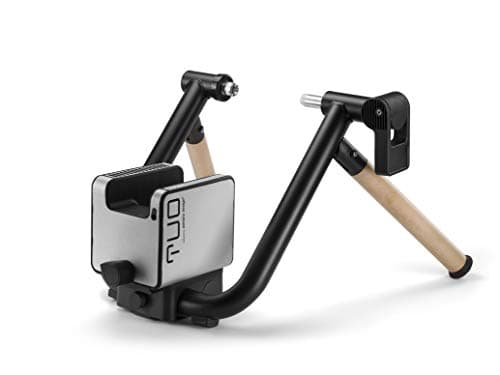 Elite Tuo The cheapest way to make your bike a stationary bike that also talks to Zwift — accept an estimated power number and buy a trainer tire. | The wheel-on trainer that also runs Zwift | 8.28.2 out of 10 | |
| 2 | 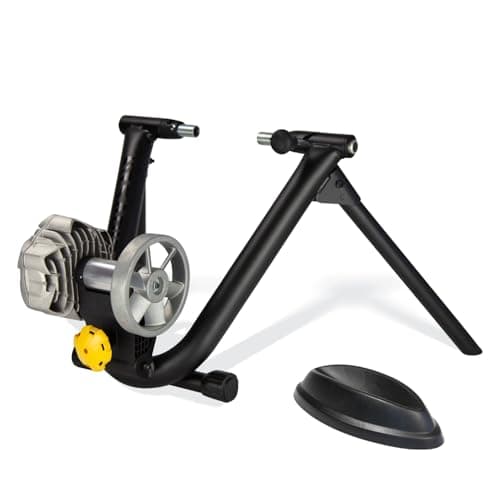 Saris Fluid2 If the question is literally 'how do I make my bike stationary' and apps are not part of it, this is the durable, quiet, no-electronics answer. | No apps, no power cord, just a bike that stays still | 7.87.8 out of 10 | $129.99 · View on Amazon $249.99Save 48% #ad We may earn a commission · Price as of September 18, 2026 |
| 3 | 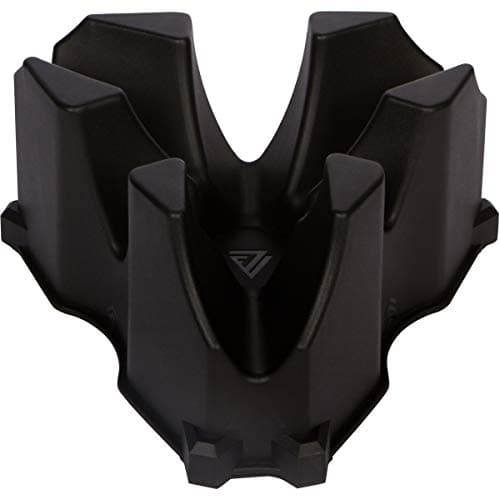 KOM Cycling Riser Block The cheapest part of the conversion and the one people skip — then wonder why their wrists ache after twenty minutes. | Levels the bike — not optional | 8.58.5 out of 10 | $34.99 · View on Amazon #ad We may earn a commission · Price as of September 18, 2026 |
| 4 | 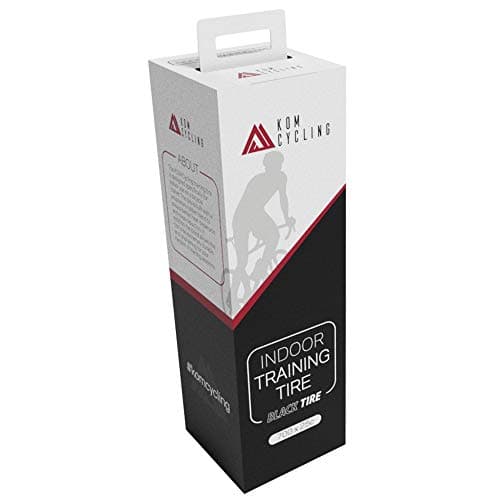 KOM Cycling Indoor Trainer Tire Not strictly required — but the difference between a trainer you use and one that annoys the household. | Protects your road tire and cuts the noise | 8.28.2 out of 10 | $29.99 · View on Amazon #ad We may earn a commission · Price as of September 18, 2026 |
Setting it up
Fit the trainer tire if you are using one, and inflate it to the pressure the tire maker lists. Open the trainer's legs on a flat floor. Set the cup width to your axle standard and clamp the rear axle; on a thru-axle bike, fit the adapter or replacement axle first. Wind the roller against the tire until it just cannot slip when you push the wheel hard by hand — most trainers specify a number of turns after contact, and over-tightening wears the tire and kills the ride feel. Put the riser block under the front wheel. Sit on the bike and confirm the saddle is level, then ride gently for a few minutes and re-check that the roller is not slipping under load. If you are on a smart trainer, how to set up a smart trainer takes it from here; if you are heading for Zwift, Zwift setup on a budget lists what else you need in order.
Is it bad for the bike?
A wheel-on trainer loads the rear axle and dropouts in a way the road does not, and the makers say so: Wahoo's compatibility pages remind you that the rider is responsible for the frame, and every maker publishes a weight limit — Saris quotes 300 lb of rider and bike for the Fluid2, and our weight-limit guide collects the rest. Carbon frames are fine on a trainer within those limits; what damages them is a bike that is clamped crooked or rocked hard against a fixed axle in a sprint. Clamp it square, use a trainer skewer where the maker supplies one, and keep the sweat off the headset with a sweat guard, and your bike will come out of the winter no worse than it went in.
Ready to pick a trainer?
See the best wheel-on trainers, rankedThe full reviews
Every pick, in detail
The wheel-on trainer that also runs Zwift
Elite Tuo
8.28.2 out of 10The cheapest way to make your bike a stationary bike that also talks to Zwift — accept an estimated power number and buy a trainer tire.
- Type
- Wheel-on, controllable resistance
- Wheel sizes
- 26 in to 29 in
- Fittings listed
- QR 130-135, 12 x 142, 135 variants, Boost 148
- Max resistance
- 1,300 W at 40 km/h
- Max gradient
- 10%
- Connectivity
- ANT+, Bluetooth
- Weight
- 10.3 kg, folds
What we'd praise
- Your bike goes on with both wheels fitted; nothing to remove, no cassette to buy
- Apps control the resistance and read cadence and estimated power, so it is a stationary bike and a Zwift trainer at once
- Folds and weighs 10.3 kg — it disappears behind a door between rides
- Elite lists fittings for 26 to 29 in wheels and for both quick-release and thru-axle bikes
What we'd flag
- Power is estimated at ±5% — enough for a game, not for a plan you set zones from
- 1,300 W and 10% are modest ceilings; a strong rider will spin out on a virtual descent
- Needs a slick trainer tire to be quiet and to protect your road tire
The Tuo is the pick for anyone who wants their bike to become a stationary bike this weekend and a Zwift bike next month. It clamps the rear axle, presses an Elastogel roller against the tire, and lets an app set the resistance. Elite rates it for 26 to 29 inch wheels and lists both quick-release and thru-axle fittings. Our turbo trainers roundup ranks it against the other wheel-on units, and best budget smart trainers shows what the next step up buys.
No apps, no power cord, just a bike that stays still
Saris Fluid2
7.87.8 out of 10$249.99Save 48%
#ad We may earn a commission · Price as of September 18, 2026
If the question is literally 'how do I make my bike stationary' and apps are not part of it, this is the durable, quiet, no-electronics answer.
- Type
- Wheel-on, fluid resistance
- Resistance control
- Progressive — rises with wheel speed, no electronics
- Wheel sizes
- 650b, 700c, 27.5 in to 2.0 in, 29 in to 1.5 in slick
- Dropouts
- 120, 130 and 135 mm QR; 142/148 thru-axle adapter sold separately
- Max weight
- 300 lb, rider and bike
- Noise
- 69 dB at 20 mph (Saris)
What we'd praise
- Nothing to pair, charge or update — clamp the bike, shift gears for resistance, ride
- Fluid resistance rises with speed, so it feels progressively like a road rather than a fixed brake
- 300 lb combined rider-and-bike limit, the highest on this page
- Made in the USA, folds, and about as durable as trainers get
What we'd flag
- No power data and no app control in the box — adding a speed sensor gets it into Zwift as an estimate only
- Thru-axle bikes need the separate Saris adapter
- Saris recommends a trainer tire and does not include one
The Fluid2 is what most people picture when they say "bike trainer": a folding steel frame, a fluid resistance unit, a roller against the rear tire. Saris rates it for 300 lb of rider and bike together, supports three quick-release widths in the box, sells a thru-axle adapter separately, and quotes 69 dB at 20 mph. There is no power cord. If you later want Zwift, a speed sensor gets it in as an estimated-power trainer — our smart trainer vs dumb trainer guide explains what that does and does not give you.
Levels the bike — not optional
KOM Cycling Riser Block
8.58.5 out of 10#ad We may earn a commission · Price as of September 18, 2026
The cheapest part of the conversion and the one people skip — then wonder why their wrists ache after twenty minutes.
- Heights
- Three positions
- Fit
- Road and mountain tire widths
- Base
- Wide, non-slip footprint
- Use
- Wheel-on and direct-drive trainers
What we'd praise
- A wheel-on trainer lifts the rear axle, so without a block the bike sits nose-down and your saddle tilts forward
- Three heights let you match the trainer's axle height or add a little climb
- Stops the front wheel wandering, which is what makes a stationary bike feel stationary
What we'd flag
- A stack of books does the same job for a week — but slides, and eventually you buy one
- Not a steering block; the front wheel is fixed
Every wheel-on trainer lifts the rear of the bike by the height of its roller, and a bike that sits nose-down puts your weight on your hands and tilts the saddle. A riser block under the front wheel restores the geometry and stops the wheel wandering. Our riser block roundup covers the options, including one that steers.
Protects your road tire and cuts the noise
KOM Cycling Indoor Trainer Tire
8.28.2 out of 10#ad We may earn a commission · Price as of September 18, 2026
Not strictly required — but the difference between a trainer you use and one that annoys the household.
- Size
- 700 x 25c
- Compound
- Purpose-made indoor compound
- Tread
- Slick
- Use
- Indoor only — never on the road
What we'd praise
- A road tire on a roller squares off, sheds rubber and hums; a trainer compound resists heat and runs quieter
- 700 x 25c fits the width most modern road bikes run
- Cheap enough to fit to a spare wheel and forget
What we'd flag
- One width only — 28c and wider setups, and mountain bike wheels, need a different tire
- Unsafe on the road, so if it lives on your only rear wheel you are swapping tires every time
Both Saris and Elite recommend a trainer tire on their wheel-on units, and the reason is heat: a roller pressed against a road tire builds temperature the compound was never designed for, and the tire wears fast and hums. A slick indoor compound fixes both. If you own a spare rear wheel, fit it there and the conversion becomes a wheel swap. Our trainer tire roundup covers widths and the sacrificial-road-tire alternative.
Good questions
Frequently asked questions
How do I turn my regular bike into a stationary bike?
Put it on a bike trainer. A wheel-on trainer clamps the rear axle and presses a roller against the rear tire, keeping both wheels on; a direct-drive trainer replaces the rear wheel with its own cassette. Add a front wheel riser block so the bike sits level and, on a wheel-on unit, a slick trainer tire.
Can I use a mountain bike on a bike trainer?
Yes. Wheel-on trainers like the Elite Tuo are rated for 26 to 29 inch wheels, and Saris lists the Fluid2 for 27.5 inch tires up to 2.0 inch and 29 inch up to 1.5 inch without tread. Fit a slick tire, because knobby tires are loud and slip on a roller. Boost 148 thru-axle bikes need an adapter on wheel-on trainers.
Do I need a special tire for a bike trainer?
Not strictly, but both Saris and Elite recommend one. A road tire pressed against a roller heats up, wears flat and hums; a purpose-made trainer tire resists heat and runs quieter. The convenient approach is a spare rear wheel with a trainer tire fitted. Trainer tires must never be used on the road.
Does a bike trainer damage your bike?
Not when the bike is clamped square, the rider and bike are within the trainer's published weight limit, and sweat is kept off the frame. Trainers load the rear axle differently from the road, so use the skewer or adapter the maker supplies and avoid rocking the bike violently on a fixed trainer. Wahoo's compatibility pages list a few specific frames that do not fit at all.
Can I turn my bike into a stationary bike without a trainer?
Rollers are the only other option: three drums in a frame that the bike rides on unattached. They are cheap and excellent for technique but the bike is not fixed, so you balance while you ride. For a stationary bike in the ordinary sense, a trainer is the answer.
Does a wheel-on trainer work with Zwift?
A controllable wheel-on trainer like the Elite Tuo does: the app sets resistance and reads estimated power and cadence. A fluid trainer like the Saris Fluid2 can join Zwift with a speed sensor, but Zwift then estimates power from wheel speed and cannot control the resistance.
Why does my bike feel tilted on a trainer?
Because a wheel-on trainer lifts the rear axle by the height of its roller, so the front sits lower than the rear. A front wheel riser block restores a level bike and stops the front wheel wandering. It is the cheapest part of the setup and the one most often skipped.
How we sourced this
- Saris — Fluid2 trainer (wheel sizes and tire widths, dropout settings, 300 lb rider-and-bike limit, 69 dB, trainer tire recommended, thru-axle adapter sold separately)
- Elite — Tuo specifications (26-29 in wheels, axle fittings, 1,300 W, 10%, ±5%, 10.3 kg)
- Wahoo — Bicycle Frame Compatibility [KICKR] (frame responsibility, supported wheel sizes and hub standards)
- DC Rainmaker — Elite Tuo smart trainer in-depth review
Keep going