Trainer Review
Elite Justo Review
A real optical torque sensor, a 24% gradient ceiling and flagship accuracy at a price the flagships do not match. The catch is a radio, and it is worth understanding before you buy.

For years the shape of the trainer market was simple: Wahoo and Tacx owned the flagship tier, Elite owned the tier below it, and the gap between them was measured in accuracy claims. The Justo was Elite's attempt to close that gap directly — an optical torque sensor measuring power rather than a model inferring it, a claimed ±1%, a 24% gradient ceiling and a 6.2 kg flywheel, at a price the flagships were not matching.
It largely worked, and it remains the most interesting value proposition at the top of the market. But it has one clear omission and a successor that fixes it, so the useful review covers both.
The optical torque sensor is the reason this trainer exists
There are two ways a trainer knows your wattage. The cheaper way is to model it: the trainer knows how much braking force it is applying and how fast the flywheel is turning, and it calculates what you must be producing. The Elite Rivo does this and says so honestly, listing power as estimated at ±2.5%.
The more expensive way is to measure it — put a strain gauge or an optical sensor in the load path and read the actual torque. That is what the Justo does, and it is why Elite can claim ±1% rather than ±2.5% on hardware that otherwise looks similar. It is the same order of engineering as a bike-mounted power meter, and it is what separates the tier. The cheapest Elite on the measured side of that line is the Avanti, which carries the same sensor class with a lighter flywheel and a lower gradient ceiling.
Does ±1% matter to you? Honestly, only in specific circumstances. Structured training works on repeatability — reading the same way every session — and a ±2% trainer gives you that perfectly well. What ±1% buys is cross-device comparison: racing against a field, or following a plan built on an FTP measured outdoors. Our accuracy guide lays out the whole argument.
| Elite Justo | Elite Justo 2 | Kickr v6 | Tacx Neo 2T | |
|---|---|---|---|---|
| Claimed accuracy | ±1% | Under ±1% | ±1% | ±1% |
| Power measurement | Optical torque sensor | Optical torque sensor | Strain-gauge based | Motor-based |
| Max resistance | 2,300 W at 40 km/h | 2,400 W | 2,200 W | 2,200 W |
| Max gradient | 24% | 24% | 20% | 25% |
| Flywheel | 6.2 kg | 7.2 kg | 16 lb | Simulated |
| Onboard WiFi | No | Yes | Yes | No |
| Fast data rate | No | 10 Hz | Model dependent | No |
| Cassette included | Version dependent | 12-speed fitted | No | No |
| Descent drive | No | No | No | Yes |
24% is real headroom, and mostly theater
Elite quotes 24%, second in the mainstream field only to the Tacx Neo's 25%, and comfortably above the Kickr v6's 20%. It is a genuine engineering achievement and it will almost never change your riding.
Zwift's hardest sustained climbs sit below that figure, and most riders run trainer difficulty below 100% anyway, which scales the simulated gradient down so a virtual wall does not demand a gear the bike does not have. Where a high ceiling genuinely helps is heavier riders on steep sections at full difficulty, where a lower-ceiling trainer runs out of resistance and the climb quietly flattens out.
The 2,300 W figure deserves a note in Elite's favor: it is quoted at 40 km/h. Resistance capability on an electromagnetic trainer depends on flywheel speed, so a maximum published without a speed qualifier is close to meaningless. Several better-known brands publish it without one. Elite does not.
The missing WiFi, and how much it should bother you
The original Justo connects over ANT+ FE-C and Bluetooth. That is what the entire category used until recently and it works — but Bluetooth is the single most common failure point in indoor cycling. It was designed for short-range accessories in a quiet radio environment, not a room with a tablet, a phone, a head unit, a strap and a speaker in it. Dropouts mid-interval, ERG quietly ceasing to hold, a controllable connection downgrading to power-only: our troubleshooting guideis essentially a catalog of Bluetooth's failure modes.
WiFi removes the link entirely — the trainer joins your home network and talks to the app over IP. The Justo 2 adds it, along with automatic over-the-air firmware updates, which is a genuine quality-of-life gain on a product that gets updated.
How much this matters is entirely situational. If your current setup connects reliably to a tablet two feet away, WiFi is a convenience. If you ride in a garage a long way from the router, or a flat with a dozen networks in range, it is the fix. Be honest about which you are before paying the difference.
Flywheel, frame flex, and how it rides
At 6.2 kg — 7.2 kg on the Justo 2 — this is a heavy flywheel by any standard, and flywheel mass is what carries your momentum through the dead spots at the top and bottom of the pedal stroke. The Justo feels settled and heavy in the way a good trainer should, closer to the flagship experience than to the mid-tier.
The frame also flexes laterally under load, which is not the same as a movement rail and should not be sold as one. It takes some of the harshness off a rigid platform, particularly out of the saddle. It does not travel, and it will not solve saddle discomfort on a three-hour ride the way a rail or a set of motion plates does.
Living with it
This is a heavy, permanent trainer — it does not fold and you will not be carrying it upstairs often. Give it a mat, both for the floor and for the sweat, and give the room a serious fan, which changes more about how an hour indoors feels than any drive unit does.
Cassette arrangements vary by version and region: the Justo 2 is sold with a 12-speed road cassette fitted, while the original is version dependent. Check before ordering, and see our cassette guide for matching one to your chain if you are supplying your own.
Who should buy it
Buy a Justo if you want measured ±1% power and a 24% ceiling and you would rather not pay Wahoo or Garmin prices for them. It is the best-value flagship-class trainer in the market and the arrival of the Justo 2 has made the original better value still.
Buy elsewhere if connectivity is your recurring problem — the Kickr v6 and Kickr Core 2both have WiFi and Wahoo's app support is the strongest in the category — or if ride feel is what you are actually shopping for, in which case the Tacx Neo 3M is a different kind of machine altogether. The full ranking puts all of them in order.
Shopping the top tier?
See how the Justo ranks against the flagshipsThe comparison most buyers run from here is against Wahoo's flagship, which has the WiFi the Justo lacks and a heavier flywheel: Elite Justo vs Wahoo Kickr v6 goes through it specification by specification, including whether the gradient and resistance advantages on paper are ones you will ever use.
The full reviews
Every pick, in detail
Best flagship value
Elite Justo
8.78.7 out of 10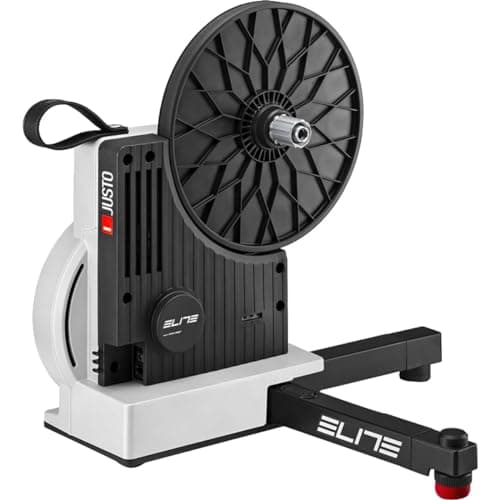
#ad We may earn a commission · Price as of October 22, 2026
The cheapest honest route to a ±1% flagship-class trainer, as long as you can live without WiFi and are buying on the discount the Justo 2 has created.
- Type
- Direct drive, electromagnetic
- Claimed accuracy
- ±1% (optical torque sensor)
- Max resistance
- 2,300 W at 40 km/h
- Max gradient
- 24%
- Flywheel
- 6.2 kg
- Connectivity
- ANT+ FE-C, Bluetooth
What we'd praise
- ±1% from a real optical torque sensor, at a price well below Wahoo and Garmin's ±1% trainers
- 24% gradient ceiling is second only to the Tacx Neo in the mainstream field
- Lateral flex in the frame takes the hard edge off a fixed trainer without a rail or plates
- 2,300 W at 40 km/h is quoted with the speed qualifier, which is the honest way to publish it
- 6.2 kg flywheel gives a genuinely settled ride
What we'd flag
- No WiFi — the single biggest omission, and the reason the Justo 2 exists
- Elite's app ecosystem is weaker than Wahoo's or Garmin's
- Heavy and awkward to move; this is a permanent installation
- Superseded by the Justo 2, so firmware attention will taper over time
The Justo was Elite's move upmarket: an optical torque sensor rather than a resistance model, a 6.2 kg flywheel, a 24% gradient ceiling and a frame that flexes side to side under load. On paper it went straight at the Kickr v6 and the Neo 2T, and largely matched them.
Its one real gap was connectivity. The Justo talks ANT+ and Bluetooth only, and it launched into a market where the flagship competition had already added WiFi.
The current version
Elite Justo 2
8.98.9 out of 10
The Justo with its one flaw fixed and a heavier flywheel. Better trainer, worse value than the original on discount.
- Type
- Direct drive, electromagnetic
- Claimed accuracy
- Under ±1% (optical torque sensor)
- Max resistance
- 2,400 W
- Max gradient
- 24%
- Flywheel
- 7.2 kg
- Connectivity
- WiFi, ANT+ FE-C, Bluetooth, 10 Hz data
What we'd praise
- Adds the WiFi the original Justo was missing, with automatic firmware updates over the air
- 10 Hz data transmission, which matters if you race online
- 7.2 kg flywheel, up a full kilogram on the original — the heaviest in Elite's range
- Ships with a 12-speed road cassette pre-installed
What we'd flag
- Costs meaningfully more than a discounted original Justo
- Everything else is an increment: same 24% ceiling, same architecture, near-identical accuracy claim
- Availability through Amazon is inconsistent
The Justo 2 is a targeted revision rather than a redesign. WiFi arrives, data transmission goes to 10 Hz, the flywheel goes from 6.2 to 7.2 kg and the resistance ceiling nudges to 2,400 W. The accuracy claim tightens marginally, to under ±1%.
If you were going to buy a Justo new anyway, buy this one. If the original is discounted, the question is simply whether WiFi is worth the gap — and for most people in a normal house with a nearby tablet, it is closer than the marketing suggests.
Good questions
Frequently asked questions
What is the difference between the Elite Justo and the Justo 2?
The Justo 2 adds onboard WiFi with automatic firmware updates, raises data transmission to 10 Hz, increases the flywheel from 6.2 kg to 7.2 kg and lifts maximum resistance from 2,300 W to 2,400 W. The 24% gradient ceiling, the optical torque sensor architecture and the roughly ±1% accuracy claim carry over.
Does the Elite Justo have WiFi?
The original Justo does not — it connects over ANT+ FE-C and Bluetooth only. WiFi arrived with the Justo 2, along with over-the-air firmware updates. If your current Bluetooth setup connects reliably it is a convenience; if you ride in a garage far from the router or a flat with crowded airwaves, it is a genuine fix.
Is the Elite Justo accurate enough for racing?
Yes. It uses an optical torque sensor that measures torque in the load path rather than inferring power from a resistance model, and Elite claims ±1% — the same figure Wahoo and Garmin publish on their flagships. That is the tier where your number stands up next to another rider's hardware.
How steep a gradient can the Elite Justo simulate?
Twenty-four percent, second only to the Tacx Neo's 25% in the mainstream field and above the Kickr v6's 20%. In practice almost nobody meets that limit, because most riders run Zwift's trainer difficulty below 100%, which scales the simulated gradient down. It matters most to heavier riders on steep sections at full difficulty.
Is the Elite Justo better than a Wahoo Kickr v6?
On paper it matches or beats it: the same ±1% claim, a higher 24% gradient ceiling and more resistance. The v6 answers with onboard WiFi, a heavier 16 lb flywheel and better app support. If price is equal, most riders are better served by the v6; the Justo's case is that it usually is not equal.
Does the Elite Justo come with a cassette?
It varies by version and region. The Justo 2 is sold with a 12-speed road cassette pre-installed; the original Justo is version dependent, so check the listing. If you are supplying your own, it must match your chain's speed count or shifting will be poor and wear will be fast.
How we sourced this
- Elite Justo 2 specifications (manufacturer)
- Elite Justo smart trainer in-depth review (DC Rainmaker)
- Elite Justo 2 smart trainer review (Cyclingnews)
- New Elite Justo smart trainer: side-to-side movement and greater accuracy (BikeRadar)
- Elite knowledge base: WiFi setup and firmware updates on Avanti, Justo 2 and Rivo
Keep going