Trainer Review
Tacx Neo 3M Review
Garmin folded the motion plates into the trainer and asked flagship-plus money for it. The ride is the best there is. The value case is a much harder argument.

Every other direct-drive trainer works the same way: you turn a belt, the belt spins a heavy flywheel, and an electromagnetic brake decides how hard that is. The Tacx Neo does not have a belt or a flywheel. It has a large direct-drive motor that both applies resistance and, when the software asks, applies power in the other direction. Everything unusual about how a Neo rides follows from that one architectural decision.
The Neo 3M is the current expression of it, and the headline change over the Neo 2Tis that Garmin's motion plates — previously a separate accessory — are now built into the base. The trainer travels about 5 cm fore and aft as you ride and leans further laterally than the 2T managed, and the motion can be switched off when you would rather it did not.
What the motor architecture actually buys you
Three things, and they are the whole case for the trainer.
Descent simulation. On a flywheel trainer, a descent means the resistance drops and you coast. On a Neo, the motor drives the drivetrain, so a downhill in Zwift spins your legs up the way a real descent does. It is the one feature in indoor cycling that genuinely surprises people the first time. It is also the only function that needs the mains cable — everything else works unplugged, which is unique in this class.
Road-surface simulation. Because the motor can modulate resistance far faster than a brake can, the Neo can reproduce texture: cobbles, gravel, wooden boards. It is a novelty for some riders and a genuine engagement tool for others, and it costs nothing to switch off.
A 125 kg virtual flywheel.With no physical flywheel, inertia is simulated, and Tacx simulates a great deal of it. The result is the settled, heavy-bike feeling that riders describe as the Neo's signature — momentum that carries you through the dead spot rather than a machine you have to keep punching.
The motion plates, and how they differ from a rail
A bike outdoors is never still. It rocks fore and aft as you accelerate and ease, and it leans under your stroke. You do not notice because the motion is small and continuous, but its effect is that no part of your body stays loaded in the same way for long. A fixed trainer stops all of it, which is why a rider who is comfortable for five hours on the road starts fidgeting after seventy minutes indoors.
The 3M restores about 5 cm of fore-aft travel — roughly 2.5 cm each way — plus the lateral flex the Neo frame has always had, a little more freely than before. The important distinction against Wahoo's approach is scale: the Kickr Moveputs the whole trainer on a longer rail with more travel. The Neo's plates are subtler. Riders who want a clear, obvious movement generally prefer the Move; riders who want the fixed-trainer harshness taken off without the bike wandering generally prefer the plates. Neither leans the way a rocker plate or a smart bike does.
The lock-out matters more than the spec sheet suggests. Movement is welcome on a two-hour endurance ride and actively unhelpful during a seated over-under set where you want a stable platform. Being able to switch it off is the feature that makes it liveable.
| Tacx Neo 3M | Tacx Neo 2T | Kickr Move | Kickr v6 | |
|---|---|---|---|---|
| Type | Motor direct drive | Motor direct drive | Direct drive on rail | Direct drive, fixed |
| Claimed accuracy | ±1% | ±1% | ±1% | ±1% |
| Max resistance | 2,200 W | 2,200 W | 2,200 W | 2,200 W |
| Max gradient | 25% | 25% | 20% | 20% |
| Flywheel | 125 kg simulated | Simulated | 16 lb | 16 lb |
| Movement | Built-in motion plates | Frame flex only | Fore-aft rail | Axis feet flex |
| Descent drive | Yes | Yes | No | No |
| Road-surface effects | Yes | Yes | No | No |
| Onboard WiFi | No | No | Yes | Yes |
| Runs unplugged | Yes, except descent drive | Yes, except descent drive | No | No |
Accuracy: excellent, and not the reason to buy it
Garmin claims ±1% for power, and the platform's reputation for holding an ERG target cleanly through transitions is deserved. If you want your indoor number to line up with an outdoor power meter, this is among the safest hardware you can own.
But note the first row of that table. The Neo 2T, the Kickr Move and the Kickr v6 all claim ±1% too, and the Kickr Core 2claims ±2%, which is five watts at 250 W. Buying the 3M for its accuracy figure means paying a very large premium for a number several cheaper trainers also print. Our accuracy guide explains why the gap between ±1% and ±2% matters far less than most shoppers assume.
25% gradient, 2,200 W, and honest expectations
Twenty-five percent is the steepest simulated gradient in the mainstream field and it is close to theater. Zwift's hardest sustained climbs sit below it, most riders run a reduced trainer-difficulty setting anyway, and a 25% wall on a road bike gearing setup is not a training stimulus so much as an ending. Treat it as headroom, not as a feature.
Two thousand two hundred watts is the same story: a figure a strong amateur touches for a couple of seconds a few times a season. Neither number should decide a purchase at this level, because every trainer in the comparison meets them or comes close.
Noise, footprint and living with it
The Neo is as close to silent as this category gets. There is no belt and no flywheel whirr; what you hear is your drivetrain and, under sustained high power, an internal cooling fan. In an apartment or an upstairs room that is worth real money — see our quietest smart trainers ranking and the apartment pain cave guide for how much of the remaining noise is structural rather than airborne.
The trade is bulk. This is a heavy trainer with a long footprint and motion travel to allow for, so it wants a permanent home rather than a corner it gets carried to. Put a mat under it, both for the floor and because the plates want a consistent surface.
If the question you arrived with is whether to pay the 3M premium over a Neo 2T, Tacx Neo 2T vs Neo 3M answers it directly — the two share every performance figure, and the decision comes down to the plates.
Who should buy it
Buy the Neo 3M if you have decided that how the ride feels is the thing you are upgrading, if you ride long sessions indoors, and if the price is genuinely not the constraint. Nothing else reproduces a bicycle this convincingly without becoming a smart bike.
Buy something else in almost every other case. If you want movement, the Move comparison makes the argument properly. If you want the Neo ride for less, a discounted Neo 2T is the value play in the whole category. And if you are upgrading from a wheel-on trainer, the full ranking will point you somewhere far cheaper with no meaningful loss to your training.
Shopping the top of the market?
See how the Neo 3M ranks against the fieldFor the cross-shop most buyers at this price actually run, see Kickr v6 vs Tacx Neo 3M.
The full reviews
Every pick, in detail
Best trainer feel, at a price
Garmin Tacx Neo 3M
8.88.8 out of 10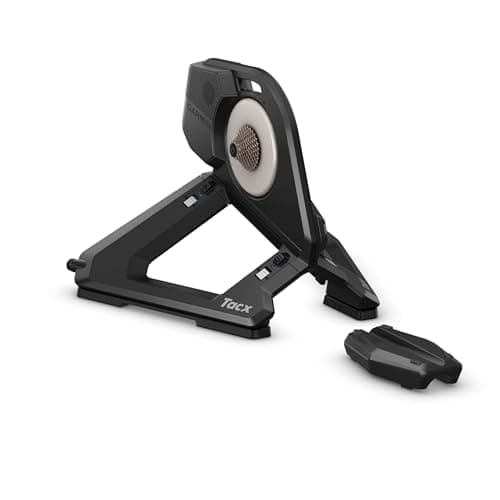
#ad We may earn a commission · Price as of October 21, 2026
The most convincing simulation of riding a bicycle that a trainer currently produces, sold at a price that only makes sense if ride feel is the reason you are shopping.
- Type
- Direct drive, motor-driven, no physical flywheel
- Claimed accuracy
- ±1%
- Max resistance
- 2,200 W
- Max gradient
- 25%
- Virtual flywheel
- 125 kg simulated
- Movement
- Built-in motion plates, 5 cm fore-aft travel
What we'd praise
- Motion plates are built in rather than an accessory, and they can be locked out when you do not want them
- Descent simulation actively drives the drivetrain downhill, which no belt-and-flywheel trainer can do
- Road-surface simulation reproduces cobbles and gravel through the pedals
- Runs without mains power for normal riding — only the downhill drive needs the cable
- Near-silent, so it is a genuine option in a shared or upstairs room
What we'd flag
- By some distance the most expensive way to buy ±1% and 2,200 W
- The Kickr v6 offers onboard WiFi for roughly half the money, and the Kickr Move that used to undercut it on movement was discontinued by Wahoo in June 2026
- Heavy and long — this is a trainer that gets a permanent floor position, not a cupboard
- The Neo 2T delivers most of the same ride at a fraction of the price when discounted
The Neo line has always been architecturally different from everything else: no belt, no physical flywheel, a direct-drive motor that both resists and drives. The 3M adds Garmin's motion plates to the base of that machine rather than selling them separately, so the whole trainer travels roughly 5 cm fore and aft and leans a little further side to side than the 2T did.
What you are buying is feel. The data is excellent but not meaningfully better than several cheaper trainers; the ride is better than all of them. Our Neo 2T review explains the platform, and Kickr Move vs Neo 3M is the comparison most buyers at this level actually need.
Good questions
Frequently asked questions
What is the difference between the Tacx Neo 3M and the Neo 2T?
The headline change is that Garmin's motion plates are built into the 3M's base, giving roughly 5 cm of fore-aft travel and freer lateral lean, with the option to lock the motion out. Both claim ±1% accuracy, 2,200 W maximum resistance and a 25% gradient ceiling, and both use the same motor-driven architecture with descent drive and road-surface simulation.
Does the Tacx Neo 3M need to be plugged in?
Not for normal riding. The trainer generates what it needs from your pedaling, so resistance, power measurement and app control all work unplugged. The mains cable is required for the downhill drive function, where the motor actively spins the drivetrain on descents.
Is the Tacx Neo 3M worth the extra money over a Kickr Move?
Only if you specifically want the Neo ride. Both claim ±1% and 2,200 W; the Move has more movement travel, adds onboard WiFi, and costs less. The Neo 3M answers back with descent drive, road-surface simulation, a 25% gradient ceiling and near-silent running. Choose on feel and features, not on data quality.
How quiet is the Tacx Neo 3M?
Very. There is no belt and no physical flywheel, so the audible noise is your own drivetrain plus an internal cooling fan that runs under sustained high power. It is one of the few trainers we would recommend without hesitation for an upstairs room, though a mat is still worth having for structure-borne vibration.
What is the Neo 3M's virtual flywheel?
Because there is no physical flywheel, inertia is generated by the motor rather than by mass. Tacx simulates roughly 125 kg of flywheel, which is what produces the heavy, settled momentum riders describe as the Neo's signature feel through the dead spot of the pedal stroke.
Can you turn the motion plates off?
Yes, and it is one of the better decisions in the design. Movement is welcome on long endurance rides and can be a distraction during seated threshold work where you want a stable platform, so the plates can be locked out and re-enabled as you like.
How we sourced this
- Tacx NEO 3M in-depth review: motion and accuracy (DC Rainmaker)
- Garmin launches the Tacx Neo 3M with integrated motion plates (Cyclingnews)
- Garmin Tacx NEO 3M smart trainer product page and specifications (manufacturer)
- Garmin Tacx Neo 3M review (OutdoorGearLab)
- Zwift supported trainers and connection protocols
Keep going