Power Meter Review
Favero Assioma Duo Review
Dual-sided pedal power at a claimed ±1%, rechargeable, and installed with a pedal wrench in five minutes. For most upgrading riders, this is where the search ends.
Most power meter decisions are a tangle of trade-offs. The Assioma Duo is notable for how few it asks you to make. It measures power in the pedals, which is the location that gives you the two things upgrading riders value most — easy installation and free movement between bikes — and it does the fundamentals so well that it's become the quiet default recommendation across the category. This review walks through what it is, who should buy it, and the handful of riders who'd be better served elsewhere.
What it is
The Assioma Duo is a pair of dual-sided power meter pedals. The measurement electronics live in a pod on the spindle of each pedal, so both your left and right legs are read independently and you get a true left/right balance figure rather than a doubled estimate. Favero claims ±1% accuracy — the same tier as the flagship pedal and spider meters from Garmin and Wahoo. It uses a Look Keo-compatible cleat, and Favero includes cleats in the box.
| Spec | Favero Assioma Duo |
|---|---|
| Type | Pedal-based, dual-sided |
| Claimed accuracy | ±1% |
| Battery | Rechargeable, ~50 hr per charge |
| Connectivity | Bluetooth + ANT+ |
| Weather rating | IP67 |
| Cleat system | Look Keo compatible |
Installation and living with it
This is where the Assioma quietly wins. Because the meter is the pedal, installation is the same as fitting any pedal — thread it into the crank arm with a pedal wrench, and you're done. There's no torque-sensitive crank swap, no chainring compatibility to check, no bonding a gauge to a specific arm. When you want the meter on a different bike — a winter trainer bike, a travel bike, a new frame — you unbolt it and move it in a few minutes. That portability is the single biggest practical reason to choose a pedal meter, and it's the theme of our best power meter pedals roundup.
Day to day, the rechargeable battery is the other quiet luxury. A magnetic clip charges both pods, and a charge lasts long enough that you'll settle into a rhythm rather than thinking about it. There are no coin cells to keep in a drawer or hunt for mid-training-block — the trade being that a flat battery on a trip needs the charger, not a corner store.
Accuracy and data
Favero claims ±1%, which puts the Duo in the top accuracy tier alongside the priciest pedal and spider meters. For the way most riders train, though, the more important quality is repeatability — reading the same watts for the same effort, ride after ride — and the Assioma has built its reputation on being consistent. If you want the fuller argument on why the absolute accuracy figure matters less than people assume, our smart trainer vs power meter guide gets into it.
Being dual-sided, the Duo also reports true left/right balance, which is the main thing it offers over the single-sided Uno. That data is genuinely useful if you're rehabbing an imbalance or working on pedaling efficiency, and merely interesting for everyone else. It broadcasts over both Bluetooth and ANT+, so it pairs with Zwift, your bike computer and every major training app — and indoors it can serve as your primary power source for numbers that match your outdoor rides.
Who it's for
The Assioma Duo is for the rider adding power who wants one meter to serve every bike, values a rechargeable battery over coin cells, and rides — or is happy to ride — a Look Keo-style cleat. If that's you, this is close to a no-brainer, and it's why it wins the top spot in our roundup. We explain how we reach that judgment, without a test lab, on our how we review page.
Alternatives worth a look
Garmin Rally (RS/RK): the pick if you want to stay on Shimano SPD-SL or genuine Look Keo cleats, with deeper Cycling Dynamics data on a Garmin head unit — at a higher price. The 200 series runs on coin cells; the current 210 series replaced them with a sealed rechargeable spindle and added convertible bodies, covered in our Garmin Rally RK210 review. Favero Assioma Uno: the same claimed ±1% and portability, single-sided, for less money, with a clean path to become a Duo later — the full head-to-head is in our Duo vs Uno comparison. 4iiii Precision 3+: the cheapest way into power if you only ride one bike and don't need the meter to move or read both legs. Favero Assioma Pro RS: Favero's newer road pedal moves the electronics into a sealed spindle, drops the pods, switches to Shimano SPD-SL cleats and runs far longer per charge, for more money and the same claimed ±1% — our Assioma Pro RS review covers whether that is worth it over the Duo. For the whole field with the sidedness decision already made, see best dual-sided power meters. If you're still weighing whether a power meter belongs ahead of other upgrades in your setup, start with do I need a smart trainer.
The full reviews
Every pick, in detail
Best overall power meter
Favero Assioma Duo
9.39.3 out of 10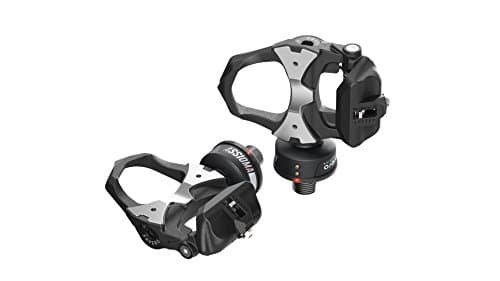
#ad We may earn a commission · Price as of October 21, 2026
The power meter we'd point most upgrading riders at — dual-sided, accurate, rechargeable, and it moves between bikes fast.
- Type
- Pedal-based, dual-sided
- Claimed accuracy
- ±1%
- Battery
- Rechargeable (~50 hr)
- Connectivity
- BT, ANT+
- Weather
- IP67 rated
- Cleats
- Look Keo compatible
What we'd praise
- Dual-sided at a claimed ±1% for a sensible price
- Installs with a pedal wrench and moves between bikes in minutes
- Rechargeable — no coin cells to keep on hand
What we'd flag
- Ties you to a Look Keo-style cleat
- Taller stack height than a bare road pedal
The Assioma Duo is the pedal meter that gets almost everything right for the upgrading rider. It reads both legs at a claimed ±1%, installs with nothing more than a pedal wrench, recharges over a magnetic clip instead of eating coin cells, and unbolts to follow you onto any bike with a Look Keo-style cleat. Favero rates it to IP67, so weather isn't a concern, and it broadcasts over both Bluetooth and ANT+.
The only reasons to look elsewhere are cleat loyalty — Shimano SPD-SL or Speedplay riders have better-fitting options — or budget, where the single-sided Uno saves money. For everyone else, this is the default. See where it sits against the field in our best power meters roundup.
Good questions
Frequently asked questions
Is the Favero Assioma Duo accurate?
Favero publishes a claimed accuracy of ±1%, which puts it in the top tier alongside the priciest pedal and spider meters. For training, its consistency ride to ride matters as much as the headline figure, and the Assioma has a strong reputation for repeatable numbers. We report the manufacturer's claim rather than a lab measurement of our own.
Does the Assioma Duo move between bikes?
Yes — that's one of its biggest strengths. Because the meter is built into the pedals, you unbolt it with a pedal wrench and swap it onto another bike in a few minutes, provided that bike uses a Look Keo-style cleat setup. One Duo can serve your road bike, trainer bike and travel bike.
What cleats does the Favero Assioma Duo use?
It uses a Look Keo-compatible cleat, and Favero includes a set in the box. If you already ride Look Keo or a compatible cleat, you're set. If you're committed to Shimano SPD-SL or Speedplay, the Garmin Rally RS/RK or the Wahoo Powrlink Zero are better-fitting options.
How is the Assioma Duo's battery charged?
It has a built-in rechargeable battery, charged over a magnetic clip that attaches to each pod — there are no coin cells to replace. A single charge lasts around 50 hours of riding by Favero's published figure, so most riders charge it occasionally rather than thinking about it. The trade-off is that a flat battery on a trip needs the charger rather than a store-bought cell.
Should I buy the Duo or the single-sided Uno?
Buy the Duo if you want true left/right balance data out of the box. Buy the Uno if you mainly want reliable, repeatable training power for less money — it shares the same claimed ±1% accuracy and can be upgraded to a Duo later by adding the second pedal. Our Duo vs Uno comparison walks through the decision in detail.
How we sourced this
Keep going
Read these next
- Gift GuideGifts for the Data-Driven Cyclist
- ReviewFavero Assioma Pro RS Review
- ComparisonFavero Assioma vs Garmin Rally
- Power MetersThe Best Budget Power Meters
- Power MetersThe Best Power Meters
- ComparisonFavero Assioma Duo vs Uno
- Power MetersBest Power Meter Pedals
- GuideDo I Need a Smart Trainer?
- Power MetersHow to Calibrate a Power Meter
- GuidesAre Power Meter Pedals Worth It?