Power Meter Review
Garmin Rally RK200 Review: Watts, Balance and the Metrics Nobody Uses
Dual-sensing pedals in the Keo standard, with a pile of Cycling Dynamics data behind them. Here is which of those numbers changes your training, and which are just interesting.
The Garmin Rally RK200 is a pair of Look Keo-compatible pedals with a power meter in each one. Garmin claims ±1% accuracy, both pedals sense independently so left/right balance is measured rather than inferred, they run on replaceable cells for roughly 120 hours, and they transmit over both ANT+ and Bluetooth. They also produce a long list of extra metrics under the heading Advanced Cycling Dynamics.
The specifications are not really in question — this is a mature product from a company that has been building pedal power meters since the original Vector. What is worth a review is the part buyers actually get wrong: deciding which of the numbers it produces should change anything about how you train.
Dual-sensing is the feature you are actually paying for
Strip away everything else and the reason to buy a 200-series Rally over a 100-series or a single-sided crank meter is that both pedals measure. A single-sided meter reads your left leg and doubles it. That is fine for training — imbalance is usually small and stable, so the number moves with your fitness rather than with your asymmetry — but it is an assumption, and there are three cases where the assumption matters.
Injury and rehabilitation. If you are coming back from a knee or hip problem on one side, balance data is the entire point, because it tells you when you have stopped guarding the leg. Bike fit work. A persistent asymmetry can be a saddle height or cleat position issue rather than a strength issue, and you cannot chase it without measuring it. Comparing to other devices. A dual-sided number lines up with a trainer or a spider meter far better than a doubled single-leg estimate does.
If none of those three describe you, be honest about it — the single-sided options in our budget power meters roundup will serve you just as well for less. Our single vs dual-sided guide is the longer version of this argument.
| Rally RK200 | Rally RK100 | Favero Assioma Duo | 4iiii Precision 3+ | |
|---|---|---|---|---|
| Type | Keo pedals | Keo pedals | Keo-compatible pedals | Crank arm |
| Sensing | Dual | Single | Dual | Left only |
| Claimed accuracy | ±1% | ±1% | ±1% | ±1% |
| Power source | Replaceable cells | Replaceable cells | Rechargeable | CR2032 |
| Claimed run time | ~120 h | ~120 h | ~50 h per charge | Up to 800 h |
| Moves between bikes | Minutes | Minutes | Minutes | No |
| Extra metrics | Advanced Cycling Dynamics | Limited | Cycling dynamics subset | Cadence |
| Exposed to pedal strikes | Yes | Yes | Yes | No |
Cycling Dynamics: two useful metrics and a lot of scenery
Garmin bundles a set of pedaling metrics with the dual-sensing pedals, and this is where new owners lose weeks. Here is our honest audit.
Left/right balance — useful. The core reason for dual sensing. Watch it over blocks rather than within a ride, because it moves with fatigue and intensity.
Seated versus standing time — useful. Genuinely actionable for pacing long climbs and for understanding why a hard indoor session felt different from an outdoor one. Also the metric most riders are surprised by.
Power phase and peak power phase — interesting. Where in the stroke your force is applied. Fascinating, and almost impossible to act on without a coach and a fit studio, because deliberately changing your pedal stroke usually makes you slower before it makes you faster, if it ever does.
Platform center offset — interesting, occasionally useful. Where on the pedal your foot presses. A consistently large offset can point at a cleat position worth adjusting, which is a real fix. It is a bike-fit diagnostic, not a training metric.
None of this is a criticism of the product. It is a warning against buying a power meter for the dashboard and then never using the one number that actually drives training, which is your wattage over time. Everything else is optional.
Batteries, and why replaceable cells matter more than they should
Garmin uses replaceable cells rather than a rechargeable pack, quoting around 120 hours. That is genuinely the right call for a power meter, and the reason is behavioral rather than technical: a rechargeable power meter is a thing you can forget to charge, and a flat power meter on the morning of a race is worse than a slightly heavier one.
The practical advice is to change both sides at once, keep spares in your toolbox, and be careful with the battery door seal — it is the part that determines whether water stays out. Cross-thread it or over-tighten it and you have created a problem the electronics never had.
Garmin took the other view with the current generation: the Rally RK210 is the same Keo pedal with a sealed rechargeable spindle and no battery door at all, rated at up to 90 hours with a 15-minute fast charge. If the door is the part of this design you are nervous about, that is the pedal to read about next.
The pedal-strike question
This is the one genuine structural risk of the pedal category and it deserves stating plainly. Your power meter is the part of the bike closest to the ground, on the outside, at the widest point. A crank meter is protected by the crank; a pedal meter is not protected by anything. A hard strike on a curb or a rock can end an expensive pedal in a way it would never end a crank arm.
For road riding on tarmac this is a low-probability event and not a reason to avoid pedals. If your riding includes gravel, technical corners or racing in a bunch where contact happens, weigh it seriously — a crank power meter is the risk-free alternative, at the cost of never moving between bikes.
Living with them indoors
Worth knowing if this is an indoor-first purchase: on a smart traineryour pedals and your trainer will both report power, and they will not agree exactly. That is normal. They measure at different points in the drivetrain — pedals at the source, trainer after the chain — so drivetrain losses alone account for a few percent, before either device's tolerance is considered.
The fix is not to chase the difference but to pick one source and stay with it. Most riders set the power meter as the power source and the trainer as the controllable device, which gives consistent numbers indoors and out. Our accuracy guide explains why repeatability beats absolute agreement, and how to calibrate a power meter covers the zero-offset routine that keeps the pedals honest.
Who should buy it
Buy the RK200 if you already ride Keo cleats and want the most convenient dual-sided power meter available; if you own several bikes and want the meter to follow you; if you have a genuine reason to care about left/right balance. It is a mature, accurate, well-supported product and the installation is trivial.
Skip it if your shoes are SPD-SL — buy the RS200 and keep your cleats. Skip it if you own one bike and do not need balance data, because a crank meter delivers the same training-relevant number for considerably less. And skip the 200 for the 100 if the balance figure is the only thing pushing you up a tier — same accuracy claim, one sensing pedal, less money. The whole field is ranked in best power meter pedals.
Still deciding?
Compare the RK200 against the whole fieldThe full reviews
Every pick, in detail
Best dual-sensing pedals for Keo riders
Garmin Rally RK200
9.19.1 out of 10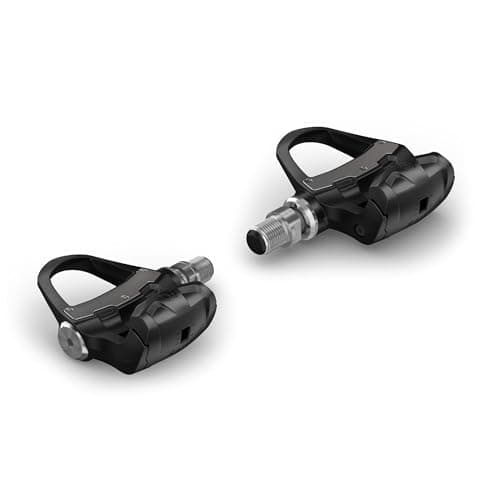
#ad We may earn a commission · Price as of October 21, 2026
The most convenient way to own a genuinely dual-sided power meter, in the cleat system most of the enthusiast market already uses.
- Pedal body
- Look Keo compatible
- Sensing
- Dual — both pedals measure
- Claimed accuracy
- ±1%
- Battery
- Replaceable cells, around 120 hours
- Metrics
- Advanced Cycling Dynamics
- Connectivity
- Bluetooth and ANT+
What we'd praise
- Both pedals measure independently, so left/right balance is measured rather than estimated
- Fits with a pedal wrench in minutes and moves between bikes just as quickly
- Look Keo cleats are slim, light and the same standard Favero Assioma uses
- Replaceable cells rather than a charging routine — no cable, no dock, no forgetting
- Advanced Cycling Dynamics adds seated/standing time, power phase and platform offset
What we'd flag
- Costs more than a crank meter that reports the same wattage
- Keo cleats wear faster than SPD-SL for most riders, and worn cleats change how the pedal feels
- Pedals are the one power meter you can destroy in a single pedal strike
- Most of the Cycling Dynamics metrics are interesting rather than actionable
The RK200 is the Look Keo version of Garmin's dual-sensing pedal power meter. Both pedals contain their own strain gauges, so the left/right balance figure is a measurement rather than an assumption, and Garmin claims ±1% accuracy. Installation is a pedal wrench and about five minutes, which is the single biggest practical advantage the whole pedal category has over cranks and spiders.
Everything electronic in it is identical to the RS200; the difference is the pedal body and therefore the cleat on your shoe. We settle which body to pick in RS200 vs RK200, and the short version is that it should follow the shoes you already own.
Good questions
Frequently asked questions
What is the difference between the Garmin Rally RK200 and RS200?
Only the pedal body and therefore the cleat. The RK200 uses Look Keo compatible bodies, the RS200 uses Shimano SPD-SL. The electronics, the ±1% accuracy claim, the dual-sensing measurement, the battery life and the metrics are identical, so the decision should follow the cleats already on your shoes.
Is dual-sensing worth paying for on the Rally RK200?
It is if you need measured left/right balance — during injury rehabilitation, for bike-fit diagnosis, or when comparing numbers against another device. If none of those apply, a single-sided meter tracks your training just as well because imbalance is usually small and stable, and it costs considerably less.
How long do Garmin Rally RK200 batteries last?
Garmin quotes around 120 hours from replaceable cells. Change both sides at the same time, keep spares in your toolbox, and take care with the battery door seal, since that is what keeps water out of the pedal.
Which Cycling Dynamics metrics are actually useful?
Left/right balance and seated versus standing time are the two worth acting on. Power phase and platform center offset are interesting and can occasionally flag a cleat position worth adjusting, but deliberately changing your pedal stroke based on them rarely makes anyone faster.
Why do my Rally pedals and my smart trainer show different power?
Because they measure at different points. Pedals measure at the source, before the chain; a trainer measures after drivetrain losses, which are typically a few percent. Add each device's own tolerance and a small gap is expected. Pick one source, use it consistently, and do not chase the difference.
Can I use the Rally RK200 on a gravel or mountain bike?
Only if you want a road cleat on that bike, and with the pedal-strike risk in mind. Garmin sells conversion kits between the pedal bodies in the Rally family, but the RK200 as sold is a road pedal, and pedals are the most exposed place on a bike to put an expensive sensor.
How we sourced this
Keep going